
The nostalgia factor, and why purely maths-based gameplay leads to stagnation.
Let’s talk about how damaging nostalgia can be.
Every action RPG seems to live in Diablo II‘s eternal shadow. This is not a good thing. How many of the Diablo II hype-men are even old enough to have played it prior to the Resurrection remake? Or is it literally just 40-plus-year-old blokes? Which would, honestly, be really sad.
For years, the popular refrain from the fans when complaining about anything they didn’t like in any new dungeon crawler was, effectively, ‘just remake Diablo II‘. There is this persistent eulogising of this game from the very start of the century that portrays it as somehow a perfect experience. Forgetting, as just one example, how awkward melee could be, relying more on gear than most other classes, to be comparably effective. That’s pretty consistent for the genre in general, but that doesn’t it isn’t a flaw.
So now we have Diablo II: Resurrected. Solved. You’d be forgiven for assuming that, having gotten what they asked for, the mortuary cult of Diablo II would shut up leave everyone to move on without them? You’d be wrong. Diablo IV‘s initial itemisation was… awkward. More on that later, but the players weren’t impressed. Obviously, the first thing people screamed was something about Diablo II. They did the same thing in Diablo III. In Wolcen‘s early days, the expected cheerleader squad showed up right on time to go through the tired routine about Diablo II. I’m pretty sure that it doesn’t matter what you say around this crowd, you just have to mention their favourite game. You could copy—paste a quarterly report from Simon & Schuster, but insert the name ‘Diablo II‘ at random into the text, and you’d get the same hysteria.
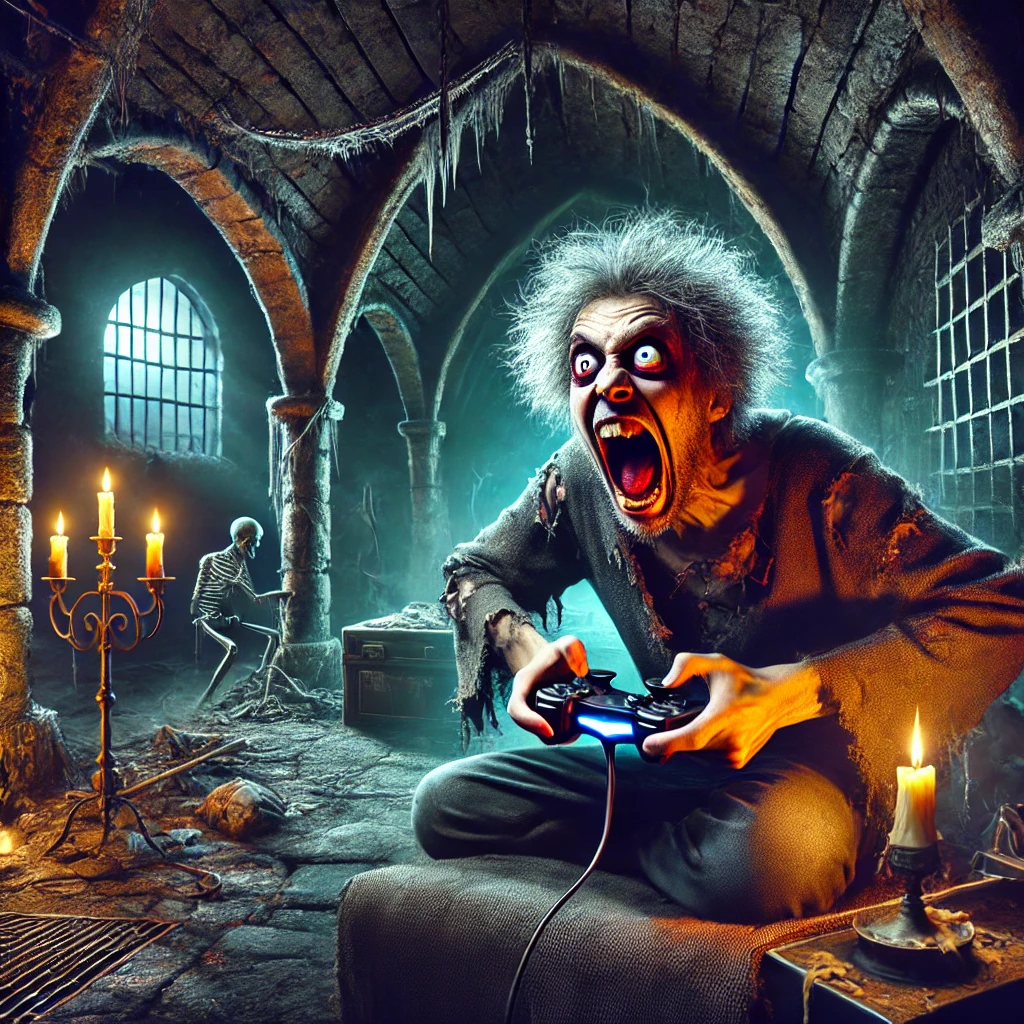
Like I said, though, it wasn’t perfect. Classes had exactly the same gear, everyone was running around looking for the same rune words and the same unique items. How about endless Stone of Jordan farming? Great times, not tedious and repetitive at all! All this despite the perpetual screeching about how no games have end game anymore and they need to be more like Diablo II… Are these people serious? Diablo II was nothing but Baal and Mephisto runs.
All of which is to say that this is a braindead narrative that leaves us with a repeating loop of: any changes developers make to the Diablo II formula is screamed about because it’s not Diablo II, and developers remake the systems as close to Diablo II as they can to avoid triggering the fanbase. But nobody can even accurately remember Diablo II without a foot-thick layer of nostalgia prettying the memories up. Switch between the Resurrected remake graphics and the default graphics, and you’ll see this — the reason we liked the remakes visuals so much is because this how we remembered the game in our own minds from back when we were teenagers. Look at it now, and it’s low-res, fuzzy as hell and you’re mostly filling in the fine details through your own head.
I’m of the opinion that the majority of players don’t actually care about hardcore community’s borderline fetishistic obsession with a game two decades old. They’d rather see less sweaty gatekeeping and more innovation, but are neither bothered enough to all caps on forums about it, or dedicated enough to keep playing beyond the first couple of weeks of any season.
We’ve had the ability to move away from pure number crunching for a long time now, but when you do that, there’s a surprising amount of the ARPG fanbase that kick off because it’s not ‘traditional’. So the developers are mostly stuck with a sounding board consisting of an increasingly outspoken but increasingly loud cadre of basement dwellers who refuse to let the genre move on, while actively harming it with their puritanical attitudes.
Game development is extremely costly, and only getting more so — both in time and money. Which seems to indicate that, at a base level, the chance to create a successful product lessens over time. In turn, this means that if the developers can’t create games that appeal to a broader audience who are looking for something fresher, but also cannot satisfy the inbuilt audience who no longer seem to know what they want, then you’re setting every product up for failure.
This weird puritanism in the ARPG scene that is both regressive and damaging to the genre as a whole. Developers who advance the core mechanics more than hyper-incremental baby steps can receive the most ridiculous backlash — including going so far as to spill over into personal abuse and death threats. Because gamers are normal like that. There seems to be this nebulous list of things that an ARPG is and isn’t, but it’s not really agreed on or it seems to shift violently depending on different circumstance — not in and of itself bad, but the things that cause the shifts concerning what is and isn’t an ARPG, are absurd.
An ARPG should, according to some, never have WASD movement. Why? Because trying to do WASD movement and use skill buttons simultaneously is terrible, and there’s surely no alternative control system to work with that. Also, Diablo II had click-to-move and if you don’t have click-to-move then it’s not a “true” ARPG because it doesn’t look exactly like Diablo II. Want to select abilities easier? Use your fucking mouse wheel.
Click-to-move at this point is just a bizarre, and frankly stupid, choice. You’re usually using the mouse to move in one direction while also moving the mouse to aim in another direction. So you’re constantly just zig-zagging the cursor from one side of the screen to the other. This is awkward, it can result in misclicks. I have no idea why Diablo IV and Last Epoch didn’t incorporate it, but in both cases the omission was deliberate.
What about that system is good? Various ARPGs are now already playable on controllers – which are sort of achieving the WASD plus mouse aim mechanics already. Some argue that changing to a WASD control scheme, changes the entire genre from ARPG to twin-stick shooter. Which is just weird. Again, we’ve got this odd linking of a genre to a control scheme. But if ‘action role playing’ is depending on the way in which you control the character, surely you’d call the genre ‘click to move’ — as with ‘twin-stick shooter’? The logic just doesn’t work. So again, what is the actual argument against modernising the control scheme? To be fair, I think the click-to-move fundamentalists are a dying breed. Looking around, increasingly you will find people choosing controller if they can’t have WASD — for obvious reasons.
Similarly, there seems to be this lingering, fundamentally backwards idea that if the player is not viewed from an isometric perspective then it’s not an ARPG. Again, this is just rooted in nostalgia. Traditionalists have a real thing about not deviating from their sacred of formula, it’s like there’s some KFC herbs and spices or the Coca Cola recipe locked in a Blizzard vault somewhere, but for Diablo II. It’s just salt and sugar, guys. I’m pretty sure that if you could pry the rose-tinted glasses out of the groves in your skull you might get it.
Ok, question: if you shift the camera to a God of War style over-the-shoulder perspective, but keep everything else, is an ARPG no longer and ARPG? Ok, the movement would be absurd, so let’s throw in WASD for convenience. Is this theoretical game no longer an ARPG? If not, why? What about the camera angle is so intrinsic to the genre? And why?
People freaked out about Diablo IV going open world, spuriously assigning World of Warcraft comparisons. This was nonsensical because conflating an open world map with one particular genre is to firstly ignore the a vast chunk of the rest of games media for about two decades, and secondly to commit a laughable false equivalence.
This perspective somehow argues that the genre is dependent on every area always being broken up into specific maps. Overlooking the fact that breaking a map up into chunks and instances is usually either gameplay dependent, such as if you need different sections like dungeons to be re-randomised each time you enter. Alternatively, especially in the 90s and 2000s, there were technical limitations and you couldn’t put all the content you wanted into a single giant landmass. Which, in turn, is quite fitting, because the kinds of people arguing these kinds of points, have never moved past 2010. They just sort hit a mental wall at the end of that decade and refused to move thereafter.
To perfectly exemplify this, we have people arguing that the genre is not about mechanical complexity. Things like timing and button pressing and pattern recognition is forgone, instead the “skill” is character building.
But why not both? Where does this bizarre zero-sum thinking come from? Surely if you added the skill-based mechanical depth to the genre, you could just deepen and elaborate on the pre-existing mechanics? There’s seems to be this idiot notion that if you have skill-based mechanics then you cannot also have passive trees and character builds and all the rest of it. As an easy example: How many new things could be synergise around positioning, with advantages when attacking from a particular direction, or elevation?
Some might argue that you have to forego complex mechanics because the players are dealing tens of millions of damage a second and nothing lives long enough to justify the skill. Which, again, doesn’t add up: What part of the words ‘action role playing game’ inherently implies ‘big number’? Why is ‘big number’ inherently better? This is a speed and damage tweak and it’s all relative to the specific game, not an inherent part of the genre. If you mod the relative damage output of Diablo II to be ten-times smaller, would it cease to be an ARPG? No.
Some might argue that anything that isn’t centred around a repetitive grind means that a game is not an ARPG. Despite the fact that the repetitive grind approach isn’t working. Look at Diablo IV. It’s got a tonne of content that is effectively ‘run dungeons and kill monsters’ under various guises — from the Tree of Hanging Berks to Surf’s Up in Hell to the Hole in the Ground with a million levels (if it’s clear I haven’t played Diablo IV since season 1, it’s because I haven’t played Diablo IV since season 1). People are still complaining left, right, and centre that the game somehow still doesn’t have an ‘end game’ or that the end game isn’t good enough. If that is true, then can the playerbase please define what an ‘end game’ is and figure out what the fuck they actually want?
Others argue that it’s about ‘keeping the roots’. Purists like this argument because it’s both tedious to argue with, implies that the ‘roots’ have some intrinsic value and must be preserved at all costs. Why? Well, because they are the roots and therefore they must preserved. Around and around we go. I find this kind of argument funny, because it implies that mouse movement and the camera perspective are the core tenants of the genre. Which they would themselves go on to furiously deny if I showed them Baldur’s Gate and called it an ARPG. And they’d argue that it then had to be ‘fully real time’ and so we could show them Project Zomboid, which fits all the parameters so far — click to move, isometric, and real time. And then we could talk about loot and modifiers. Zomboid doesn’t lack for loot — half the game is about looting. The game has a skill system, so in theory that base is already covered.
Ok, but what about item modifiers? Well, that’s an interesting argument — what in particular counts as a modifier when in conjunction with ARPGs? If I have a quality modifier on an item — so if I pick up a pipe and it can roll ‘damaged’, ‘broken’, ‘cracked’, ‘bent’, ‘sturdy’, ‘perfect’, ‘new’, ‘rusty’ as modifiers and a colour and/or a length — so you’d come out with something like ‘a short, damaged blue pipe’… would that mean that Project Zomboid constituted an ARPG? Those modifiers may not be ‘+1 strength’ or ‘chance to cast fireball on hit’, because it wouldn’t fit the tone of the game, but they are modifiers. Ok, but what about randomised levels? Ok, you could make a randomised map generator. But what about dungeons? Ok, you could create a bunch of assets and scripts that turned every building into a randomly generated structure with an entrance at one end and a boss and loot at the other.
If you did all of this, would the ARPG puritans consider Project Zomboid to be an ARPG?
It’s possible that the natural evolution of the genre is towards something more akin to a SoulsBorneRing, a twin-stick shooter, a roguelike, or a God of War-influenced game. There’s all manner of direction that the subgenre has the potential to embrace and diversify away from the traditionalist mould. Titles when allowed to explore new ideas, mechanics, and perspectives could grow beyond yet another tired imitation of Diablo II, but the developers are going to, ironically, have to start ignoring their loudest fans and be somewhat bolder in their approach.
It seems like the only thing keeping the Diablo-clone alive is nostalgia at this point. If the isometric click-to-move model is effectively irrelevant at this stage, then why are we even preserving it? If the traditions of the subgenre are somehow dependent to these elements, but are effectively obsolete, then why not just move on?
 Words and Chaos
Leave a comment