Player interactions with mechanics and how attempts to control chance spawn non-optional options.
The wrong options
When Diablo IV arrived in June 2023 it was very clear very quickly that it had some issues. The itemisation was dubious and after months of hyping up the ‘social’ aspects of the game, it remains, over a full year later, one of the most anti-social online experiences in recent memory. Even Diablo III managed to implement a group finder at launch, but apparently this technology, available since the late 90s, is beyond Activision-Blizzard. At the time of writing in mid-August 2024 Diablo IV was still reliant on third party applications like Discord to handle rudimentary multiplayer interactions. It did receive a group finder with the Vessel of Hatred expansion update. Arguably of greater importance, they overhauled the troubling itemisation.
Here’s the thing: The complaints about the initial itemisation in Diablo IV weren’t unfounded, but to an extent, were misdirected. Diablo IV‘s initial itemisation had a bunch of interesting gameplay altering properties, notably several positional and distance-related conditionals. There seems to be a reasonable segment of the ARPG base that don’t really like conditionals — they just want a bigger number because bigger number equals more powerful and more powerful equals more dopamine. It seems a bit boring to me, but to each their own I suppose. Personally, I am in favour of conditionals.

Why are conditionals good? Conditionals in themselves are great but hard to manage. One of the main problems with Diablo IV‘s initial itemisation was stacked conditionals. A percentage chance to do X in Y circumstance is great, but in general the number of conditions relative to base effect should be either singular or very limited. More is not better.
The way the itemisation was characterised and what the itemisation actually was, are two relatively separate things. The general characterisation was that every item description amounted to: ‘one hit the player has a 2.5% chance to do 2.5% extra damage every second Tuesday in May if the player is 25’. Understandably frustrating, but actually the real problem was far worse. In the above example, it all implies a singular set of variables around one interaction. In reality, the conditionals, individually, were totally readable and pretty simple to understand, but their lack of focus required a dump truck full of Ritalin to make sense of and there were multiple interactions per item. Weapons had three of four different conditionals, all affecting different interactions and none of the which synergised. That’s where the confusion came from. Nobody could make anything coherent out any singular item, let alone a full set of gear. Trying to figure out how to direct the gear you were prioritising was an exercise in absurdism.
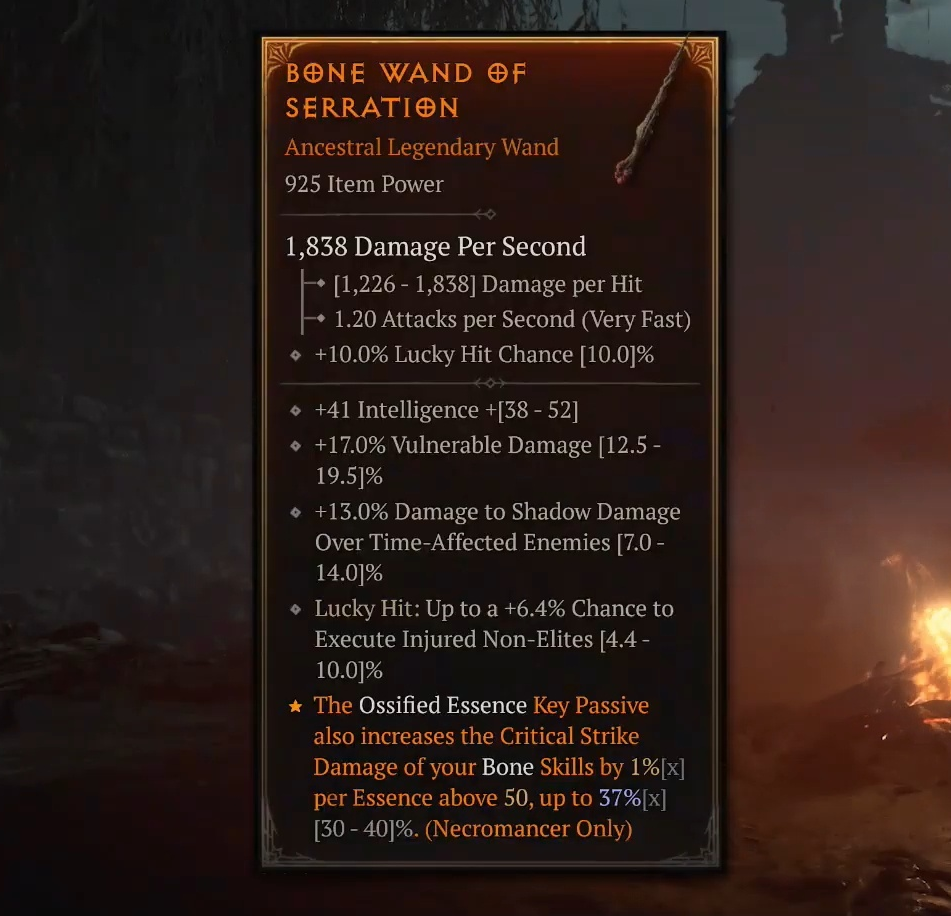
The above is pre-itemisation overhaul, and is meant to be illustrative, rather than a comment on itemisation as it currently stands. As far as I can tell, the individual conditionals break down as such (from the third bullet down):
1: (Percentage of damage) to (damage type) if (enemy condition 1).
This is straightforward, it works, nothing to see here.
2: (Chance) to trigger (effect) if (enemy condition 2) (enemy rank).
Rank is really a bit of a shrug, but I can see it as an encouragement for player builds to attempt to choose between ‘elite hunter’ or ‘trash clearer’ focuses. It’s just a bit convoluted when it’s folded into another conditional. Arguably, it also doesn’t work because you haven’t got that many ranks of enemies to divide into. If you’re going to start specifying enemy ranks — champions, elites, unique — then realistically you’d make that its own separate conditional.
3: (Crit. damage) of (skill type) dependent on (resource stack).
That’s also fine. That’s easy to follow and simple enough that you can synergise it with other bits of equipment.
Taken together, each of these effects for a single piece of gear is suggesting a different set of priorities. Working from the bottom up they are suggesting:
- A necromancer focussed on bone skills, specialising in critical hit chance and resource generation. So far, so good;
- Then they’re saying the critical hit chance should also target non-elites — so the player is a trash mob clearer specialising in clearing entire packs in 1—2 hits. The first hit injures, the second hit executes anything remaining and injured. OK, well that’s a very narrow specification, but feasible;
- Finally, the first conditional is saying that the crit. chance bone skills, should also be damage over time and focus on a specific elemental damage type. Which, if it exists at all, is probably going to apply to a single skill.
That’s specific enough on one bit of gear. Then players need to apply the same logic to 10—11 different items that support this hyper-niche design. In reality, all of the items the player gets are going to roll them a tonne of different, potentially conflicting information. This just leads to analysis paralysis, confusion, or worse indifference. Effectively the second effect is where even an advanced build would probably cap out for design complexity. Otherwise the player is pulled in far too many different directions and character building becomes futile.
This is to say nothing of how boring this all is. I think the intention was to support build variety by hyper-focussing on the ways in which the skills would be used, which is respectable. But this seems to have come at the expense of one of the major things that people liked about Diablo II‘s itemisation: that you had the chance to roll skill procs for random spells. It wasn’t particularly effective on its own, it probably had nothing to do with anyone’s build, but at the core of it just running around a field full of demons as a barbarian or a wolf dude, throwing out rings of ice magic at every other time a gremlin took a punt at you, was fun. It was stupid but it had the novelty factor.
I wonder if the lack of this kind of thing was due to the developers inadvertently taking on the efficiency mantra. Every aspect of the game gets shaved down into supporting the industrial item farming machine at the expense of goofy add-ons that are just fun to play with. The problem with turning your ARPG into an industrial item farming machine is that the vast majority of the player base just wants to hit shit with an mace. They aren’t there to turn their downtime into another job that doesn’t pay them. I had fun with just watching the ragdolls in Diablo IV. Hurling dudes across a room or over the side of a bridge, never stopped getting old.
Some of the affixes were interesting in that they seemed to be trying to push the active playstyle in a certain direction. Which is genuinely what the genre needs, things that emphasize certain tactical decisions and manners of approach. This, I think, was the point of the ‘Damage to/Reduction vs Close/Distant Enemies’ — encouraging an active playstyle choice to stay a certain distance from your target at all times, which means you have to take positioning into account more actively. But with the genre mostly locked at a fixed flat perspective, any additive nuance or variation on top of that gets lost – ignoring the fact that the players never really found enough reason to engage with positional considerations to begin with. So tactical play was a moot point from the start. But who can blame them — when the tried and tested screen-clear button is still the most efficient, why do anything else?
How much could the genre benefit from basic considerations like whether you want to attack from an elevated point? Do you want to attack head-on or circle to the flanks and surprise? This in turn opens up a wealth of mobility considerations, ie: if you’re a melee character and you think you’ll be attacked from difficult to reach places, do you take a leap so you can effectively prioritise those snipers, or would you prefer to tank the damage, charge into the main pack and finish the snipers once they’ve got nobody left to hide behind? And how do you add interesting variety and options for specification to each of those options? Alternatively you could fold it into the itemisation — do you have a chance for boots to roll an affix to double jump, or just jump twice as far/high? Do you have a skill that you can spec into that allows for wall running?
Or would you rather just mouse click move and mouse click on the enemy and mouse click move again…?
Make a choice
Baldur’s Gate 3 has some of the best itemisation of any game in the broader RPG genre. There’s usually only one effect per item. It significantly alters the way something specific works. It’s one of the few games where I have repeatedly found items with genuinely interesting gameplay altering effects, not just ‘+4 to virginity’ (which is a highly ironic take from a bloke who has rambled on about this banal shit for literally thousands of words at this point). But I can’t remember the last time I saw an ARPG with something like The Shattered Flail, which has the following effect: ‘Hitting an enemy with this weapon heals the wielder for 1—6 hit points, but they can go mad if they don’t continue hitting an enemy each turn.’
‘Mad’ is an actual effect, it makes that character attack the nearest thing to them, friend or foe. I love trade-offs like this. You get a benefit, but you get a risk, too. It’s interesting, it’s engaging. If I ever have time to do a second Baldur’s Gate 3 playthrough, I specifically want to do something with that flail, because you know that there are probably a bunch of items that have other bizarre effects which might chain and synergise with either madness or healing on hit, or allow you lean into the ‘continue hitting things as if your life depends on it because it genuinely might’ angle. Nothing in Diablo IV‘s itemisation grabbed my attention like that. It’s the reason that suicide-vampire synergy I talked about in the previous post was so endearing.
Why don’t more games do this? I get that players are generally risk averse, but I also think you have to bully players into making interesting choices instead of just handing them obvious positive/negative ramifications. Force their hands. Some will whine, of course they will, someone is always going to whine, so do it anyway.
Henry Ford was an anti-Semitic prick, but he was correct when he said: “If I had asked people what they wanted, they would have said faster horses.”
People hate authors that kill their favourite characters. To oversimplify a complex point, the authors know that if they don’t, then the audience won’t be engaged. People attach to characters and so of course they want to see them happy. Congratulations, you’re a normal human. Except they don’t because then you don’t have a story. And the audience, broadly speaking, isn’t aware of this. That partially why they invest — they don’t see the cogs and chains rattling in the background. You’re not supposed to say that out loud because it sounds patronising and trying to convince people that they don’t know their own minds just bruises their little egos a little too much and they get all cancel culture on you. That’s pretty much universal. We think we know ourselves, we don’t and we don’t want to know otherwise.
This is what trips Blizzard up every so often. As much Jay Wilson, original lead designer for Diablo III, can be held responsible for overly streamlining various mechanics, his reasoning behind doing so was at least coherent. Gamers are a whole lot less coherent. Commenting on the difference between how players remember Diablo II and what Diablo II actually was, he noted the broad disconnect between memory and reality. At time this drifted entirely into fantasy, with players remembering parts of the game that were never there to begin with. But when you tell a bunch of ‘hardcore’ gamers the truth, they tend to throw massive collective tantrums. This why PR representatives in that space are so placative — because it’s just not worth dealing with yet another entitled shitstorm from a cohort of fully grown man-children.
Reality: The customer doesn’t have a fucking clue what they want, so experiment on them.
Non-optional options
There’s that quote from Civilization game-designer, Soren Johnson again, “Given the opportunity, players will optimize the fun out of a game.” Everybody does this to some extent more or less, it’s just a quirk of psychology and it’s a predominantly subconscious quirk. The weird thing about the dedicated ARPG community is that they tend to optimise the fun out of the game consciously, effectively turning a hobby into a second data entry job, without the benefit of making it a side hustle.
From there were seem to have one reason for why traditional ARPGs are so locked into the AoE screen-clear max-speed monoculture, because everything is reduced to a percentage and the amount of truly viable options decreases to ‘whatever increases the number of dice rolls over time and makes those dice land on six the highest percentage of the time’. You can, in theory, add in positional play options, stealth options, a Divinity Original Sin-style elemental interaction mechanic, intricate movement mechanics to a traditional ARPG. They will still be completely subsumed by the area of effect spam trend, because area of effect spam kills the most things the fastest in the simplest manner with the most dice rolls and thus yields a greater amount of loot over time. The game becomes: Wipe the screen as quickly as possible.
The nuances in how they wipe the screen accounts for build flavour, be that buffs, dots, or crowd control, glass cannon, etc, but effectively the player is still driven to ‘push one button to make 50 things die’. Nowhere is this more prevalent than in Path of Exile, where melee is mostly a bad suggestion, and if you do go melee you’re still effectively a ranged area of effect build.
So what you’ve got, effectively, is a non-optional option. You can choose something else… but you’d be stupid to do so. The ‘whatever increases the number of dice rolls over time and makes those dice land on six the highest percentage of the time’ outcome in theory does allow for some interesting things to happen and the build innovation in ARPG communities is thoroughly impressive. However, the area of effect efficiency spam is so persistent with pure numbers-based gameplay, that, because all it takes is one guy with a spreadsheet to break everything, the entire game becomes warped around the inevitability of screen-clear tactics. Because when your only tool is numbers, then everything becomes a maths problem.
Skill-based mechanics allow for different approaches to a problem — stealth, brute force, close range, hit and run, etc — but their execution is dependent on the player’s competency, not on the player’s ability to enter equations into Excel.
There is a reason one pet name for Path of Exile is ‘path of life nodes’. After you’ve got all the essential build nodes to equip all your gear and cast all your spells, you just go around getting as much life and resistance nodes as possible. This is the reason they are removing life nodes in Path of Exile 2 — because it’s a prime example of players optimising the fun out of the game. It’s the same reason Diablo III removed stat allocations. The players threw massive tantrums over it, but the fact of the matter was that they didn’t actually add to build variety. Everyone sunk the minimum points necessary into the stats required to equip the end game gear they wanted, and then put everything else into buffing their health pools. Even knowing this, the tantrums continued. Why? Who knows. I guess the players wanted the option of making a mandatory choice?
Resistances often become this, too. You are compelled to stack as much resistance gear as possible in later difficulties, because if you don’t then you suffer. It became another different stick to beat the player over the head with. Elemental damage considerations are good, they force the player to make some considerations and engage with the mechanics a little more — this is not bad in and of itself. However, if you’re going to just spec into resistances because the other option is death, then you’ve got another non-optional option.
If the player can’t use skill to avoid or block the attacks then you compel them to invest into resistances. So the players find ways to optimise into all of them until they reach an arbitrary cap assigned by the developers, and then you resume the one-button area of effect spam. The player just has, effectively, fewer options to work with despite a seemingly larger pool. Everything else become a trap.
Ideally you’d make the resistances come at a trade off – you can have immunity to fire but you become doubly susceptible to cold. You can have more resistance to physical damage but now you’re susceptible to psychic damage. Or just a bog standard case of, for example, each resistance could have a maximum of 20 points of resistance assigned to it but there are five damage types, and you will only ever have 25 points to spend at max. At which point you have immunity to one thing and weakness to another. That’s a cool identifiable character quirk. The point being that players should always be forced to make choices and trade offs.
Skill-based gameplay allows people to double down on choices by actively choosing a tactic or a playstyle, which also allows them to compensate for inherent weaknesses. If they’re good at dodging, they can build around movement, or enhancing blocking and parries, etc. If they want to go ranged they can spec into crowd control. If they just want to become a tank, they can build for that. If they just want to out-DPS — that’s an option too. But the options are the end point here, and skill-based gameplay provides the potential for far more real options than pure behind the scenes mathematical crunch.
Crunch time
The problems that arise from the traditionalist model of the ARPG are rooted in the fact that they come from a time when developers simply didn’t have the technological bandwidth to do anything more advanced. Now, 20 years into the future, the capacity for fundamental innovation is ripe for the exploration. And it seems like developers want to take advantage of these advantages and escape the dismal randomly-generated dungeon of the Diablo II clone. This apparent in titles like No Rest for the Wicked, which seems to represent the most healthy advance seen in the genre for years. However, the genre is only now extricating itself from a hostage situation at the hands of a puritanical sect that refuses to move on or to simply get out of the way.
The broader loot-based game market is testament to the fact that there’s mileage in the mechanic, and the broader skill-based action game market characterised by a vast range of titles from Souls-likes to spectacle fighters proves the appetite for hands on gameplay is alive and well. FPS’ of various kinds have been experimenting with procedurally-generated content for well over a decade, so there’s no indication of that mechanic going of style either, if we are considering that to be a fundamental part of the ARPG.
Which, put all together, seems to indicate that there is no fundamental reason, aside from a sad traditionalist attitude, as to why the genre should be so immobile. It seems, at last that there is a chance for it to be pulled from the cloying muck of traditionalism by a few upcoming titles, but I also think that the current inflection point has as much a chance to descend as to climb. It would be a shame for the genre to decline, there is far more that it could be doing than pandering to the nostalgia of a handful of rose-tinted reminiscers, but I fear that if it does not escape that swamp, it will suffocate.
Escape — Exit — Are you sure? — Yes
Ok, that’s it. I’m done. No more rambling about the dubious term ‘action RPG’ or Diablo-clones or whatever. Honestly, this was far too much, I have no idea why I had so much to say on such a stupid topic that, contrary to the evidence, I don’t actually care all that much about. There you go, I suppose. Anyway, maybe I’ll do something more useful in the future. Peace.
 Words and Chaos
Leave a comment