Liar’s Bar and Buckshot Roulette both released in 2024. Is this an unlikely coincidence or an expression of a wider outlook?
I don’t usually go for warnings, but this one deals with suicide, so if you ain’t in the right headspace, give it a miss.
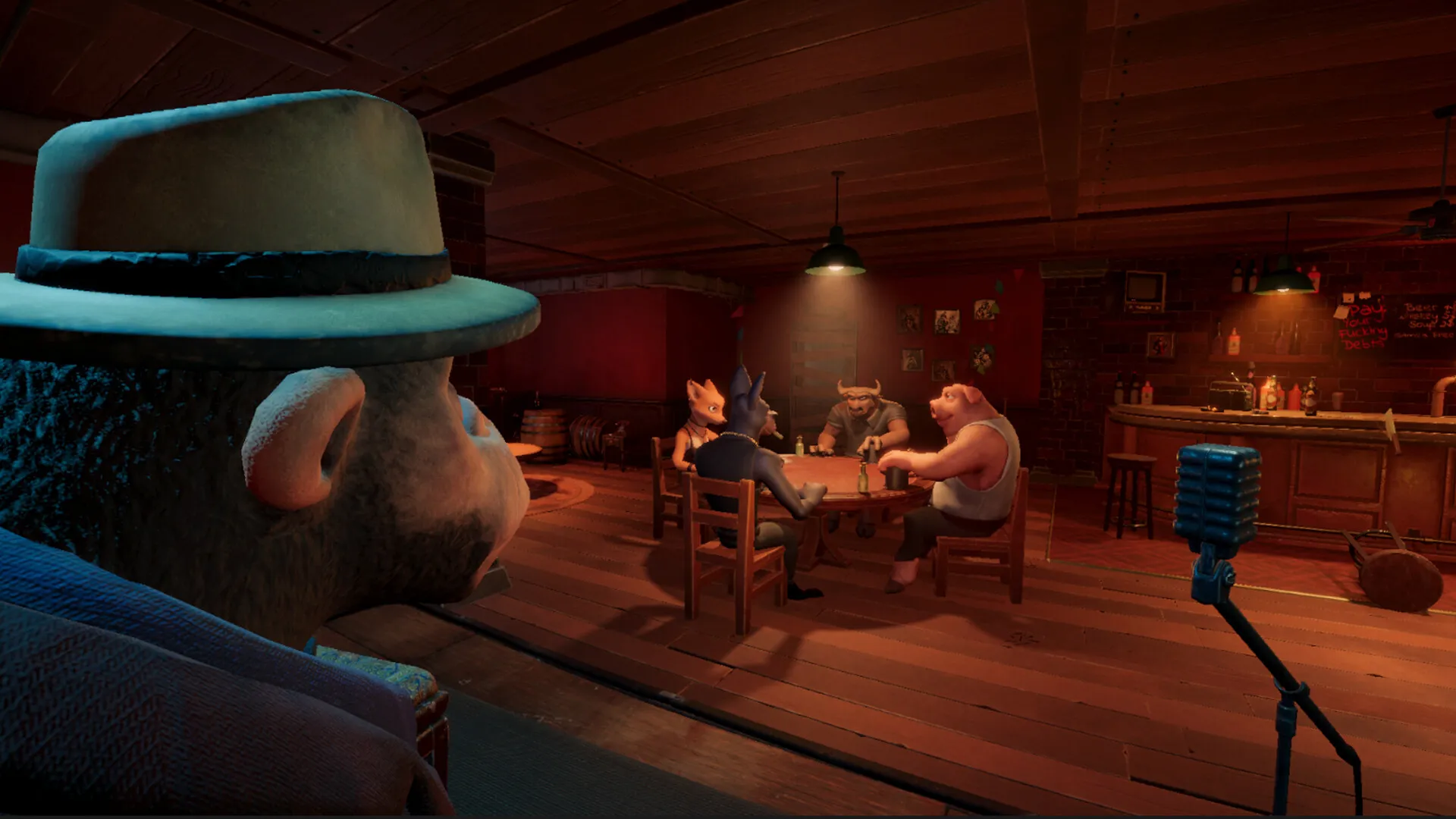
In 2024 we had two separate games that involved a take on the theme of betting with your life. The first is Liar’s Bar, developed and published by Curve Animation. It’s an darkly humorous online multiplayer take on Liar’s Dice, combining the dice game with Russian roulette via gun or poison. The second is Buckshot Roulette, developed by Mike Klubnika and published by Critical Reflex. As you might expect, it’s Russian roulette… with a shotgun. In an industrial-horror nightclub against a dealer who looks none too healthy and has gambled against God. God lost.
I thought, what are the odds that two games about wilfully gambling with your own life as a form of entertainment, come out in the same year? Then it struck me that, in a world of ever-accelerating uncertainty, risk, and precarity, maybe it makes perfect sense.
What is Russian roulette?
Russian roulette is a deadly game of chance. You find a handgun, typically one with a cylindrical chamber, and you insert a single bullet into it. You spin the chamber, and you pass the pistol on the left-hand side. Click, click, boom (shake the room). Last one alive gets… money? To walk away? I guess it depends on who’s playing.
As you might have gathered, this most depressing of entertainments comes out of Russia. In particular, a Russian writer named Mikhail Lermontov who introduced it in his story, ‘The Fatalist’. The story itself concerns a bet to disprove predestination. I’m not sure how Russian roulette proves or disproves the notion, as, regardless of the outcome, said outcome would still be the will of God if you believe in such a thing. Death proves nothing about free will. Perhaps there was more to the story – I regret to admit I’ve not read it.
Apparently, news reports of the game started to appear about 1938 in, where else, Texas, after a 21-year-old blew his brains out.
Naturally, if it is played in the contemporary era, it’s not exactly advertised – I don’t remember seeing any Facebook ads or event listings. In common parlance it has become a metaphor for taking drastic and self-destructive risks.
Taboo subjects and social norms
Some might consider Russian roulette to be a relatively taboo subject, or at least one that deserves a certain level of respect and/or gravitas. When you consider the psychology of the kind of person who might play Russian roulette, you probably arrive at a fairly bleak picture. There’s no skirting the conclusion that it is a profoundly self-destructive act. There is an implied attempt at suicide there, albeit one that is acted out in a relatively indirect fashion. You must acknowledge the loss of hope or value in your own life, perhaps both, to get to the point at which you willingly participate.
If you were hoping for some moralising sermon concerning the assertion that games should not engage with this kind of adult and uncomfortable subject matter, you’ve come to the wrong place. I fully support both developers and their respective projects. I don’t think it should be off the table, I don’t care much for taboos. They seem to act more as a silencing mechanism that works in the favour of social norms and niceties, usually to the benefit of the “elite”, and so I tend to conclude that taboos aren’t useful.
As for “respectful” treatment of subject matter, it’s difficult to gauge. I get the impression that this is not nearly as sensitive a topic as straight up suicide, probably because there are – correct me if I’m wrong – far fewer people playing Russian roulette.
Presentation at a tense table
The presentation on Liar’s Bar is deliberately cartoonish, the characters are anthropomorphic animals, and there are alternate ways of offing yourself if a gun is a little too direct for you. The atmosphere is fairly relaxed, all things considered. This irreverence actually helps the game. It would be a difficult sell to put the game ‘Liars Dice’ and suicidal gambling together and then treat it with an overt severity or even to veer into edginess. The comparably audience-friendly visuals dispel any notion that it is taking itself particularly seriously, and that may be to its benefit. You’re still trying to sell a fairly uncomfortable subject here, and you need a way to onboard people. There’s that saying: “If you’re going to tell people the truth, make them laugh or they’ll kill you.”
The levity of Liar’s Bar does not extend to Buckshot Roulette. Mike Klubnika has a now fairly significant reputation for off the wall and sometimes confrontational games. And while the presentation of this one is far from casual, it thankfully skirts the kind of teenage edginess you might come to expect from a game with Buckshot Roulette‘s industrial grunge-smeared vibe. In part this is due to the fact that Mike Klubnika has a great back catalogue that seems to make up a haphazard fragmented interconnected narrative. Whatever is wrong in the Klubnika-verse, all is very much not well. What that does for the tone of Buckshot Roulette is to carry through a sense of sincerity and continuity from title to title. While the game’s presentation is a relatively more grounded affair than that imparted by the aesthetics of Liar’s Bar, it does not overstep the mark into milquetoast shock-jock controversy baiting.
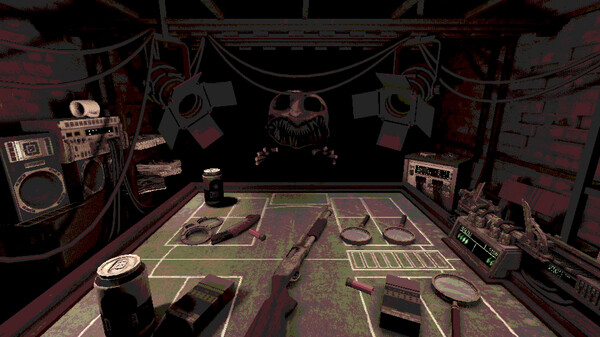
Part of the reason that the presentation works in both instances is that neither game is drawing unnecessary attention to their own subject matter. They don’t overstate themselves, they don’t use it for shock value; it’s just the base fact of their respective settings and they treat it as such. They don’t feel the need to comment on the shocking aspects of their presentations – this is particularly the case in Buckshot Roulette. Klubnika lets the audience fill in the blanks, ask the questions, supply the drama. The Dealer doesn’t ham it up by commenting on the rusted industrial defibrillators that bring you back from the dead, or deliver a Disney monologue every time he uses a magnifying glass. He explains the rules and then you get on with it. Gotta hand it to him: He is nothing if not professional.
Part of the secret to avoiding cringe and edginess is simply respecting verisimilitude. It’s effectively tied to the concept of ‘authenticity’, if that word has any meaning left in the contemporary world. Part of authenticity is not needing to draw attention to yourself, especially if what you’re doing is outlandish. Everything must at least appear to be “natural”. You cannot intentionally draw attention to it. That sounds easy, but the number of writers, musicians, developers, and people in general, who get it horribly wrong leading the audience to distance themselves, is unfortunate. They could learn a lot about presentation from guys like Klubnika.
Reflections in the splinters of society
A society. We live in one. Hurr de durr.
I have always thought that the surge of battle royale-themed media towards the latter end of the 2010s reflected not just an opportunistic cash grab, but a mass recognition of the neo-Darwinian philosophy at the core of the modern global economy – if only at a subconscious level. Apparently, I am not the only one who noticed. While the genre’s namesake itself dates back to a Japanese novel by Koushun Takami, released in 1999, and the concept has always been around, notably in the various iterations of the Big Brother reality TV format that began around the turn of the century, the format took another 15 years to see a full accelerative emergence into public consciousness.
Surprisingly, the Hunger Games series is a bit of a middle child here, with the first novel releasing in 2008. The Purge movies in 2013, openly critical of the two-tier economic structure in the wake of the 2007 financial crisis, followed the format. The game Rust would emerge as an early access project on Steam in 2013, H1Z1 would gain traction the same way in 2015. Between then and 2021, there were a multitude of battle royale-centric titles. Amongst the mass of releases, the stand-out contenders included: PUBG in 2017, Fortnite’s battle royale mode the same year, and Day Z in 2018. Finally, the stream series Squidgame caught global public consciousness, drawing attention to the near-dystopian conditions of the real-world South Korean economy-dominated culture in 2021. Since then, the concept has noticeably died down. This could be a wave of, understandable, exhaustion with the idea, alongside the mainstays of the genre now firmly rooted in place.
That media convergence was set against the ripples from the banking crisis that continued to be felt across the world, notably with the UK’s Conservative government, in the wake of The Great Recession, implementing a regime of austerity, which lasted from 2010-2019. And just as people started to wonder if there was a shred of a possibility of some returning economic stability, the successive economic nuclear explosions of the pandemic, the Russian invasion of Ukraine, and the Israel invasion of the Gaza strip and the subsequent conflict on the Yemen coast with the Houthis, disrupting global trade through the Suez Canal, put any notion of global stability firmly in the dirt.
Now carve a headstone out of the rise of the global gig economy, the fact that house prices have increased by 1010% since 1980 in the UK (according to an article from 2020), and Brexit’s impact on the broader European economic front. Then there’s the geopolitical grappling over Taiwan and its kingmaking position in the global markets, direct impacting the flood of investment and interest in the AI boom, subsequently driving business leaders from every field to throw resources into any project that promises to keep the shareholders happy, as wave after wave of layoffs roll out across the global workforce. Meanwhile, the global 1% own 38% of the global wealth, the combined wealth of US billionaires has grown 88% over the 4 years from 2020 to 2024. Those same elites hammer the post-pandemic population with schizophrenic exhortations of damnation or messages laced with tones of parental cajoling as they attempt to wrestle people back into city offices in order for commercial real estate owners to stave off an impending wave of defaults over the coming years.
As the fallout from this mass of economic circumstances has perpetuated and triggered new unforeseen events, the millennial and Gen Z cohorts that grew up in the shadow of this fractal monetary insanity have grown progressively more disillusioned in general, an attitude reflected and subsequently questioned, in their respective generational humour.
Despite the popular narrative that wages in the USA have stagnated, there appears to be a great deal of conflict regarding whether the purchasing power of the average worker has grown over time or stagnated. According to a commenter at The CATO Institute and Bloomberg, it’s a myth, while commentators at The Economic Policy Institute and pew research, insist that wages have stagnated.
According the Guardian, wage stagnation has had the the UK in a stranglehold since 2008, where inflation-adjusted weekly earnings between the banking crisis and 2022, had more or less remained exactly the same. Then again, if it’s anything like the USA, there’s probably about five different interpretations depending on who is doing the measuring and where they’re picking their data from. I’m not an economist, so my attempts to find some kind of coherent answer from people who apparently know about this stuff, has merely reinforced the idea that nobody knows anything, and it’s exhausting.
Rents in the USA have increased massively relative to purchasing power, rising 30.4% against a 20.2% income growth between 2019-2023, and increasing 175% faster than household income since the turn of the century. The UK continues its steady march into the gutter, with average monthly rents rising from £616 in 2008 to £1,258 in 2023. Given that the national economy is almost entirely dependent on London, it’s worth looking at that separately, because the average Londoner would be grateful for £1,258 a month. A decade ago, the average was £1,425 per month. In 2023 it was £1,751, according to The Standard. Meaning that there are a tonne of businesses operating in the UK, right now, offering annual salaries that barely cover the cost of annual rent after tax. If you earned £25,000 in London, which is a relatively common figure, you would have £21,271 after tax. And between £17-21k goes to your landlord.
Foodbank numbers in the UK went from 35 in 2010 to 2,800 in 2024, foodbank use went from ~26,000 people to over 3 million between 2008 and 2024. You might say, “There can’t be that many unemployed people!” You’d be right! One in five users were in employment of some kind. There are more foodbanks in modern day UK than there are McDonalds.
Now we’ve got newspeak-style articles coming out of the likes of Forbes and friends, rebranding the pre-requisite to work multiple jobs to afford a basic living, not as a 100-decibel warning siren that tells people there are problems that need serious consideration, but as “polyworking!”
Ok, stop. Look at all of the things I’ve just mentioned. These are basically headlines. This is the surface-level research of amateur armchair economic journalism. Imagine what the professionals could add to that list.
All of that is happening over roughly 18 years. That’s your context.
And so I wonder if, almost two decades later, an ever-widening wealth gap, and a slow slide towards a world in which the economy is there to stamp on everyone who wasn’t born with a free pass… we are getting another look under the gunshot residue-sprayed mask of civil society reflected in the media it gravitates towards. The disillusionment left in the wake of the mass understanding that meritocracy is a myth, has led to a state in which the gladiators left in the arena are simply too tired to perform for the affluent spectators, choosing instead to flip a coin and let the loser eat their own bullets.
Could we be seeing the emergence of an evolution or shift on the theme of the battle royale? This is still a zero-sum last-man-standing game, only now the element of chance is heightened thematically. This reflects a move away from the idea of a meritocratic model holding the primacy of individual ability as the determining factor, as reflect in the battle royale genre – survival of the fittest, the most adaptable. Now, success is conceptualised as a random affair – roll the dice, get born in the right place at the right time, win. If your first roll isn’t a winner, the rest of the rolls are just efforts towards manipulating the odds in your favour. Fundamentally, if you don’t think your actions really matter, and that reality has been boiled down to another numbers game that nobody is in control of, then why take anything seriously?
We see this play out in the real world. The wealth divide and the pervasive sense across two generations, of being shut out or left behind. In its wake, a type of scepticism seems to have emerged; an acceptance of futility and a rejection of the arrogant presumption that any free and autonomous individual is somehow duty bound to accept and enact their respective culture’s social dogmas without question. We read that Gen Z and millennials are ‘Doom spending’ in the real-world because they can’t envision a future so they don’t save. On the other hand, they apparently are more likely to have a 5-year plan than the millennials. Papers whirled into hysterics recently as Gen Z were apparently rejecting middle management and getting fired within months of being hired for being unprofessional.
Well, history teaches us that 5-year-plans tend to fail, but it’s good to know they’re thinking ahead – even if their concept of reality is broadly understood to be wildly unrealistic, informed more by TikTok feeds than experience in the outside world. Then again, what are influencers doing but reflecting the cultural zeitgeist for fun and profit? They are the modern Avon; they are there to sell you the pyramid scheme, and but instead of soap, it’s the American Dream. So, if modern ‘success’ is defined as a six-figure salary at a minimum, what do you think they’re going to expect? Their expectations are stupid, but there is a logic there.
Honestly, I don’t believe in trying to plan 5 years ahead. If life has taught me anything, it is that plans break. All you can do is pick a target and move towards it. The rest is just accounting for and adapting to whatever gets in the way, and the world is changing ever faster. Plans are inflexible. Evolution teaches us that whatever cannot change, dies.
Accurate or not, the CEO is the new symbolic aristocracy. There have been a lot of guillotine memes in last few years – on all sides of the political line. The response to the recent killing of UnitedHealthcare CEO, Brian Thompson, might indicate a turning point in the patience of the broader public. There is far less “how tragic” and far more gallows humour about death via medical insurance. The mass response to Brian Thomson’s shooting, on social media at least, was almost gleeful. Social media isn’t the best barometer of public opinion at the best of times, but for events like this, there is usually far more condemnation. The lack thereof suggests that there is a deep vein of rage running through the world at the current moment and it is not far below the surface. It says something about America’s healthcare insurance system, if not a greater social disillusionment, that the voices advocating the usual anaesthetised socially acceptable group response have either been drowned out, or are simply far fewer in number this time.
But in the logic of the game, the response makes sense.
When you turn an economy into a zero-sum last-man-standing king of the hill-style game, you can’t expect the competitors to weep when the people competing against them get knocked out of the race. The logic doesn’t run that way. The only thing that matters in that equation is that there is one less competitor trying to kill them and extract capital from their corpses. All they know is that they are still alive and they have slightly less to worry about. None of that is pretty, and I won’t endorse killing, but you would be an idiot to deny the notion that the response wasn’t understandable, if not predictable. Eat the rich yadda yadda yadda. As with any meat taken from game animals, please be sure to remove the lead first.
Perhaps this generational predilection towards irresponsible spending and almost throwaway approach to life is the less overtly self-destructive real-world equivalent to playing Russian roulette. It could reflect the psyche of two generations becoming ever more fatalistic about the future, to the extent that self-preservation becomes a suggestion. Nobody I know saves. Nobody I know expects to retire. Some of the people I know seem to be surprised that they’re still alive. I think they’re all just expecting to be taken outside and shot in the back of the head when they can no longer be of used to oil the great gears of the economy. Or just plan to get wildly drunk and set themselves on fire. There isn’t much of a sense of a future. Just survival and the hope that death doesn’t linger when it inevitably arrives.
Click, click, boom
Two points do not make a trend. But a third might indicate the beginnings of a pattern. The consumer enthusiasm for these art pieces speaks as much to the cultural psyche as does their creation in the first instance. If that enthusiasm were to transform into abstemious consumption of that it would probably indicate a trend of concerning conceptualisation at a social level. If the public were not in the frame of mind fostered by the runaway pyramid economics of our era and political capture by rogue billionaire technocrats, I have to wonder whether these two games would have received the support that they have. It awaits to be seen whether the relative success and social media traction that these projects gained, will spawn a wave of new ideation and iteration on the theme of competitive self-destruction. However, the fact that what amounts to suicidal behaviour has a certain amount of mass appeal should raise questions.
In the meantime, we spin the barrel. Last one standing wins.
 Words and Chaos
Leave a comment