Does John Locke’s Two Treatises of Government give the emergent oligarchy a stark warning?
“[…] over a long period of time, I still expect that there will be some change required to the social contract given how powerful we expect this technology to be. […] I do think the whole structure of society itself will be up for some degree of debate and reconfiguration.”
Twenty nine minutes into a keynote interview at the AI for Good Global Summit in June 2024, Sam Altman suggested that the rise of AI may require re-evaluations of the social contract. The CEO of OpenAI, creators of ChatGPT, mused on the impact of LLMs on the economy. Pressed as to whether these changes to societal structures would be led by tech companies, Altman denied any such intention. But Altman’s apparent altruism was met with scepticism by the public. And who could blame people? With tech companies now overwhelmingly dominating the global market, the S&P 500 top six companies at time of writing being tech companies, the tech-oriented NASDAQ commanding a market cap of US$22.4 trillion as of December 2023, and the ever-growing integration and infiltration of data and technology into daily life, people are naturally sceptical of the meteoric rise in influence of these companies over the past two decades. With money comes influence and with influence comes power.
The Social Contract, as a concept, has regained a notable amount of prominence over the past half decade or more. Between discussions at the start of the pandemic concerning whether we should condemn millions of people to death to preserve the economy, or the emerging debates surrounding social justice and economic inequality, exacerbated by climate change and the emergence of society-shifting technological advancements, people are more concerned than ever as to what they can and cannot expect from the societies they have situated themselves in. The World Economic Forum stuck their oars in, drawing yet more concern from everybody who were not the World Economic Forum – these being the people who proposed that by 2030 we would own nothing, have no privacy, and be happy. While Ida Auken’s essay may have been misinterpreted or misrepresented, the general response and perception might tell us something about the public’s current relationship to the extreme wealth and luxury that characterises the type of people who attend the annual Davos meetings in the Swiss Alps.
This comes on the back of the emergence of the NRx movement and the so-called ‘dark enlightenment’ founded by Curtis Yarvin and championed by the father of Accelerationism, Nick Land, and with distinct ties to Silicon Valley, NRx champions centralised authoritarian models of government and is overtly hostile to democracy. This was subsequently picked up by Curtis Yarvin, far-right blogger often operating under the pseudonym ‘Mencius Moldbug’, who subsequently championed the idea of ‘patchwork’ linked to sibling concept ‘neocameralism’. Basically, Yarvin’s grand plan is to fracture the world into a mosaic of microstates operating like corporations. Think early medieval England prior to 1066, but in a suit and tie, and the castles are replaced with glass towers. NRx thought also overlaps with eugenicist theory and scientific racism to an alarming extent. While there isn’t an apparent pervasive culture of scientific racism in Silicon Valley, the evidence seems to suggest limited subcultures do exist linked to NRx thought. More concerning, the proponents thereof all demonstrate distinct enmity towards democratic society. Yarvin’s writings have influenced and drawn overt support from other tech billionaires such as Peter Thiel, and political figures such as former White House Chief Strategist, Steve Bannon, and current US Vice President, James David Vance.
With allies like this, who needs enemies?
I’m not suggesting that Altman himself is associated with these circles or shares this perspective. I am unaware of his politics. However, the extent to which technology, power, and fascist thought overlap, has not escaped the notice of the broader public. At a time like this, when people with a great deal of influence and capital start talking about adjusting the social contract, the public are more predisposed towards heightened scepticism and hostility. The accompanying narratives of hyper-competition and representations of the ‘state of nature’ transplanted into economics advance a collective submerging back into the struggle for power between the rich and everybody else. And so we turn to the concept of the social contract. Given the state of society, it seemed as good a time as any to familiarise myself with the foundational trio of texts on which the whole murky menagerie of concepts rests. Having read Thomas Hobbes and Jean-Jacques Rousseau, I set about getting to grips with the last of the them, John Locke and his work the Two Treatises of Government.
As ever, I am no scholar. This is by no means an in-depth examination of Locke’s thoughts, quite the opposite. So take them with some amount of salt. There are many people who are better suited to give more comprehensive thoughts on social contract theory, having read not just Locke, Hobbes, and Rousseau, as primary cornerstones by which they can understand the concepts, but a vast array of literature surrounding the topic. I lack the hyperfixation to deep-dive the subject, but I am intrigued enough to attempt to educate myself concerning it, and how it may interact with present societal and economic frameworks. We still refer back to Locke, Hobbes, and Rousseau, so I suppose that gives you an idea of how persistent the core supposition of a social contract, even as a mass perceptual vagary, is to any given society.
Who was John Locke?
At a time in which you couldn’t go for a piss without bumping into one historically significant figure or another, from Hume to Cromwell, John Locke managed to stand out even in an extremely crowded market. He lived from 1632 to 1704, predominantly during the reign of Charles I. Charles I was an angry rich boy who ascended the English throne, threw a tantrum because parliament had differing opinions concerning his belief in the “divine right of kings”, and started the English Civil War. Three years later he surrendered, and 4 years after that we cut his fucking head off.
Aside from writing one of the three foundational texts associated with ‘social contract theory’, Locke was a famed political personality through several periods of his life. Locke was in close contact with the first earl of Shaftsbury, who had a fantastically interesting political career, played for both sides during the English Civil War, played a significant role in the Exclusion Crisis, and then fled into exile after a stint in the Tower of London under false charges created by some aggro toffs. Locke was also a close associate of Sir John Somers, a leading Whig and political philosopher who contributed to several key political events during the 17th and early 18th century, and who collaborated with and advised Locke on his writing. Locke also produced works on philosophy, religion, education, and economics. So we’re not dealing with an intellectual light weight. He stands, to my mind, between Hobbesian cynicism and Rousseau’s idealism.
Locke was convinced that authority derives from its legal institutions and, in particular, the consent of the governed population. He was a champion of authority so far as that authority is acting in line with the laws that it has set down. In that regard, he was far more in line with Rousseau than Hobbes, although he differed in his belief in the agency of the state. Where Rousseau would effectively frame the state as being a puppet of the ‘general will’, Locke seems to conceive of the social contract as just that – a contract. The state and the people form an agreement in which the state protects the ‘natural rights’ of the governed in exchange for taxes and fancy housing and all the trappings of society. If the state breaks that contract, the populace have the express right to destroy the state.
Every time you hear an insane NRA mouthpiece talk about how essential the second amendment is for combating government tyranny, before sucking the largest donor cock they can stretch their flaccid mouths around and ignoring any government overreach on ‘natural rights’, you’re effectively hearing Locke – only somewhat dumber and with no real political principles outside of the acquisition of wealth or the persecution of easy scapegoats.
The context of Locke’s Social Contract
Locke published the essays anonymously in 1689. Just one year previous, King James II of England was deposed by in the ‘Glorious Revolution’ by William of Orange. This came on the back of the English Civil War.
The English Civil War was the breaking point of a mixture of political and religious tensions between the British monarchy and Parliament, and the Catholic and Protestant arms of the Christian church. Cromwell, on the side of Parliamentarians, won in June 1646, and then kicked the bucket in 1658. Charles II presided over the Stuart Restoration, in which he restored the monarchy in 1660. This genius political move reignited the long-standing tensions, and also pissed off the Dutch, resulting in two separate wars. Ongoing tensions between Protestants and Catholics resulted in a spree of violence against Catholics kicked up by a weird conspiracy theory dubbed ‘the Popish plot’. This in turn kicked off debate over royal succession due to concerns over the potential of a Catholic taking the throne (because British political history wasn’t complicated enough). This ultimately split parliament into a proto form of the British parliament you’re familiar with today. Two gangs of rich idiots yelling at each other in an old hall from rows of pews, presided over by a bloke they’ve dragged up there to perform the unenviable task of moderating the opposing sides.
Charles II’s glorious answer to the ongoing feud was to dissolve parliament. This led to a plot to assassinate both him and his brother, so clearly we haven’t become any more level-headed in the intervening centuries. Charles II croaked and James II, a Catholic, inherited the throne in 1685. Concerns over his subsequent push for religious equality made the public cranky, but they were all hoping he would die quickly so his protestant daughter and her protestant Dutch boyfriend, the aforementioned Mr. Orange, would take the throne back and everybody could get back to burning more Catholics. Unfortunately, James II got to banging and produced a son, which meant there was now a Catholic line of succession.
Mr. Orange landed an army on the English coast in 1688, but just sort of stood around while the locals did the actual work. The English did what the English do best: get drunk and start trashing everything in sight. Because they wanted a Protestant king, of course. Nothing to do with England losing the World Cup again or possibly someone just told them they were on holiday. Whatever the case, the army turned against the monarchy, which is basically the nail in the coffin for any and all revolutions, and James II sodded off to Dubai or Trinidad & Tobago or… somewhere. The revolution received the epithet ‘glorious’ due to the lack of large-scale conflict and relative bloodlessness. The Oranges took the throne in 1689, the same year Locke published The Two Treatises. And you think fantasy novels have too many names….
I think I’ve got that right, more or less. If it looks like I’ve over-simplified things to an absurd degree, that’s because I have. If I hadn’t, we’d be here until next year. Early Modern England was chaotic, to say the least. A lot happened at incredible speed. I’ve probably pissed off various historians, my apologies, you’re all welcome to divide into two teams and murder each other over your various interpretations of my errors. Have fun.
So that’s the landscape Locke was writing in. I’m surprised he managed to remain so level-headed, all things considered.
Shut up and tell me about the book
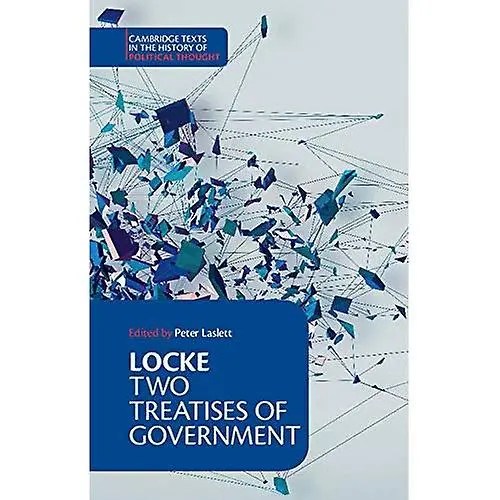
My copy is the Cambridge University Press, student edition, edited by Peter Laslett. This version keeps the old English spelling. That might turn a few people off, and if you’re unused to it, that might be a tad confusing. It’s mostly just some nonstandard spelling, but if you hated reading Shakespeare in school then you might want to find a more modern edition. What threw me off mostly was the random capitalisation. There are a fair number of instances in which it’s difficult to figure out whether Locke is referring to a proper noun or whether he just wanted to throw in a capital letter because the cat sneezed, he got a hard-on, or the wind changed direction. It’s texts like this that make you appreciate English standardisation.
Let’s talk about the “introduction”. In my look at Last Exit to Brooklyn, I talked about how I like my introductions to be short and to the point, because when I pick up a book I don’t usually care about the Editor’s thoughts. Apologies, I know you guys put a lot of work and effort and time into those essays, but I inevitably read the first few pages and then just skip to the actual content that I’m interested in reading.
The Cambridge edition is 464 pages.
The suggested reading, bibliography, other endmatter, runs from 429. (That’s pretty standard, these kinds of books have nice fat bibliographies and suggested reading so you can add yet more stuff to your ‘to read’ pile.)
The introduction is 130 pages long.
This is an introduction the way meeting your father-in-law by him walking in on you nailing his daughter while she’s upside-down and dressed in BDSM gear, is an introduction.
I’m not sure that I would know what to do with all of this information, either. I found the frontmatter far more interesting with the context because I had a defined reason for leafing through it. As an introduction, this really doesn’t introduce. This is far more in-depth than any introduction has ever needed to be. Perhaps I’m just bitching about names, here, and they should have called something else. On the other hand, if you attend a speech or a presentation, and you know it’s going to be an hour long, you don’t want the MC talking for 20 minutes. That said, more information is more good, and it makes sense, especially as this is aimed at the academic crowd. Realistically, you are more or less getting an extra text book in addition to the main essays, so while it did take me aback to find that a full third of this chunky little volume was taken up by this “introduction”, I’m more amused by the sheer girth of it than I am offended by its prodigious size.
This is another case where you’re probably more likely to read the actual texts first and then go back to the introduction, because if you haven’t, you get a tonne of information without having read the actual essays and it’s a bit pointless. Whether it would be better positioned after the treatises is debatable. Then again, perhaps it’s just presumed that you’ve already read the texts and you’re interested in this version of the books because you want an introduction like this.
As an aside, is it purposeful that this Cambridge edition has, in its opening, a distinct jab at Oxford’s rejection of Locke? “As a traditionalist institution, she mistrusted his politics, and the developed originality of his thought menaced her curriculum” (p. 23). I am, of course, biased. Traditionalism is a cancer of society that serves only to murder human progress. But it does strike me as amusing that Cambridge University Press, a direct academic rival of Oxford, is having a jab based on traditionalism. After all, England is a profoundly stunted nation with regards to social mobility. Despite our parliamentary system, I am convinced that the ruling “elite” of the UK has never forgotten the feudal system. Our problem is that we didn’t kill enough aristocrats across our history, and so, unlike the French, our aristocracy has never lost their inbred sense of entitlement. Indeed, in the wake the Black Death, these biological recursions were profoundly indignant that, with labour in demand and not much of it to go around, workers were gaining some modicum of economic power. So they stamped on it. Because we all know that the proles should never seek to grow their wealth, advance in society, or question their betters. Give the wealthy half a chance and they’d revert society back to the fragmented mass of fiefdoms that defined the early middle ages, allowing them to remain above the ‘common folk’, which is why we’ve still got assorted lords and ladies screaming bloody murder, every time there’s an infrastructure project or, God forbid, anybody tries to build affordable housing; it’s always ‘ruining their view’ or whatever.
The First Treatise
Locke’s First Treatise is responding to Robert Filmer’s Patriarchia. Patriarchia is Filmer’s argument in defence of the divine right of kings, accompanied by some quotations that he’s fond of. So, every online preacher you’ve ever run into. Filmer’s argument was, effectively, that Adam’s your daddy, and kings are descended from Adam, therefore kings are your daddy because God is Adam’s daddy. Daddies have absolute dominion and thou shalt be spanked until thy bottom is purple, should’st thou but contemplate freedom from daddies. If you want to live in a society, imagine daddy’s boot stepping on you — forever.
This is the essay you will probably skip. Few people care about it. You won’t care unless you’re specifically interested in the intersection of religious and political philosophy at the time. You know how you read the first half of The Leviathan, and then Hobbes starts banging on about the Bible you just tune out because trying to insert religious ideology into serious political thought inevitably results in impractical coils of circular logic, cherry-picking, and a multiplicity of irrational conclusions? Or how The Malleus Maleficarum is basically 20 pages of tortured reasoning being recycled ad nauseam, becoming ever-more dubious and irrational with each new loop in the argument? That’s inevitably what happens when people start shoving faith into political philosophy. That’s basically what’s going on with Filmer. As usual it devolves into a lot of ‘God of the gaps’ fallacies. Locke’s arguing against that. Filmer was pro absolute monarchy and divine mandate, and so you get a whole lot of verse quoting and several paragraphs that amount to ‘That’s nice. Here’s what that looks like in reality. Sit down and let the adults talk’.
Don’t get me wrong, I’m not just anti-faith for the sake of being edgy here. I have spent far too long learning about the fascinating schisms in Christendom during the first few centuries Common Era. There’s a lot of interesting ideas going on between various theological branches. But don’t insert that shit into real-world politics. It doesn’t fit. I refuse to countenance it or take it seriously. That goes for Christianity, Islam, Judaism, Sikhism, Hinduism, Buddhism – whatever. I respect your right to believe what you want, and there is a place for metaphysics. But you can’t pray millions of people out of poverty, starvation, or failing infrastructure. Scripture doesn’t address resource scarcity and supply chains. That’s why governments exist.
The Second Treatise
The Second Treatise is the thing you actually came for. The Second Treatise can be viewed as a response to a heavyweight in the social contract theory space, Thomas Hobbes. Like Filmer, Hobbes was pro-absolute monarchy. Unlike Filmer, he wasn’t interested in the absolute monarch on the basis of scripture, he was interested in the ruler-as-Leviathan through a fairly pragmatic lens. Leaving aside the latter half of the book in which Hobbes rambles on about scripture, the first half lays out a series of arguments grounded in political philosophy as to why an all-powerful monarch is the ideal form of government. Hobbes witnessed the chaos and violence of the English Civil War first hand. It was this that influenced his political philosophy. He was accused of being an atheist, despite so much text being devoted to Christian doctrine, though the term ‘atheist’ may have held a somewhat different meaning in the 1600s.
Hobbes effectively argues that the most stable form of government is that of the absolute sovereign, under which all areas of life are subject. Furthermore, he argues that nobody, having willingly surrendered control to the sovereign, can complain if that the actions of the sovereign harm them. In a display of stunning early modern gaslighting, Hobbes wrote: “He that complaineth of injury from his sovereign complaineth that whereof he himself is the author, and therefore ought not to accuse any man but himself, no nor himself of injury because to do injury to one’s self is impossible.”
Hobbes was doing gaslight, gatekeep, girlboss before we had the language to meme it.
How people interpret the Social Contract seems to be intimately tied to how they view the State of the Nature.
The State of Nature
Hobbes thought the State of Nature was a constant battle royale-esque omnidirectional war for survival. Rousseau thought the State of Nature was a hug box. Locke, ever the rationalist, navigates betwixt these two. According to Locke, the State of Nature is just “a state of perfect freedom”. Chapter II, ‘Of the State of Nature’ opens with:
“To understand Political Power right, and derive it from its Original, we must consider what State all Men are naturally in, and that is, a State of perfect Freedom to order their Actions and dispose of their Possessions, and Persons as they think fit, within the bounds of the Law of Nature without asking leave, or depending upon the Will of any other Man.”
Locke seems to see the State of Nature as the sum whole of a series of smaller ‘states of (noun)’. He references the ‘State of perfect Freedom’, ‘State of Equality’, ‘State of Liberty’, ‘State of Licence’, all sort of tied together by a Law of Nature, of which he says:
“The State of Nature has a Law of Nature to govern it, which obliges every one; and Reason, which is that Law, teaches all Mankind, who will but consult it, that being all equal and independent, no one ought to harm another in his Life, Health, Liberty, or Possessions.”
He reasons it out as a kind of ‘do as thou would be done by’ clause. All men are servants of God, and being his property and of a singular ‘Community of Nature’ cannot claim to be owed subordination by any other. That being the case, one is naturally obliged to preserve himself and being equal kin to other men, obliged to preserve all other people too. Just as they are obliged to preserve themselves and others, they are also obliged to punish transgressions against themselves or others in so far as such punishment furthers the peace and prosperity of human kind. He summarises, “For in that State of perfect Equality, where naturally there is no superiority or jurisdiction of one, over another, what any may do in Prosecution of that Law, every one must needs have a Right to do.”
Interpretations of the state of nature reveal perhaps less about the “human condition” and more about the author’s perception of humanity. For my own part, while I respect the moderation of Locke’s interpretation, I side more with Hobbes. Perhaps it’s the state of hyper-competition and counter-intuitive resource scarcity we find ourselves in, but I wouldn’t blame you if you slit my throat for next month’s rent. Get that bag.
The Social Contract
What does all of that have to do with Locke? Well, for a start, Locke didn’t openly advocate for licking boot so hard you could fill a pint glass with the blood leaking out of your tongue. Locke didn’t like centralising authority in a single power. It leaves open too much room for rampant abuse and damage. He wrote:
“For he that thinks absolute Power purifies Mens Bloods, and corrects the baseness of Humane Nature, need read but the History of this, or any other Age to be convinced of the contrary. He that would have been insolent and injurious in the Woods of America, would not probably be much better in a Throne; where perhaps Learning and Religion shall be found out to justifie all, that he shall do to his Subjects, and the Sword presently silence all those that dare question it.” (p. 327)
Contrary to Hobbesian exhortations to bow before a singular authority, Locke seemed to see the Social Contract between the governed and the governors as just that – a contract. If either party violates the terms and conditions of the contract, the offended party has the right to address the slight. In societal terms, this means that Locke seems to have put an emphasis on majority rule as a central tenant. Each individual has an inherent natural right to life, liberty, and property. The government is put in place by the people to protect those natural rights, and its protection thereof determines its legitimacy. The state’s role is to carry out the will of the majority:
“Whosoever therefore out of a State of Nature unite into a Community, must be understood to give up all the power necessary to the ends for which they unite into Society, to the majority of the Community, unless they expressly agreed in any number greater than the majority.” (p. 333)
And prior to that:
“For when any number of Men have, by consent of every individual, made a Community, they have thereby made that Community one Body, with a Power to Act as one Body, which is only by the will and determination of the majority. For that which acts any Community, being only the consent of the individuals of it, and it being necessary to that which is one body to move one way; it is necessary the Body should move that way whither the greater force carries it, which is the consent of the majority: or else it is impossible it should act or continue one Body, one Community, which the consent of every individual that united into it, agreed that it should; and so every one is bound by that consent to be concluded by the majority.” (pp. 331-332)
Further to this, Locke believed in the right to revolution – if a government is stepping out of line, you have the express inherent right to remind them where that line is. If they continue to fail to understand their boundaries, you have the right to remove them. Forcefully if need be. We may extend that philosophy to all authority figures. Neither your job title nor your salary entitles you to anything. You have only so much power as people are willing to grant you. If they take it back, there’s nothing you can do about it. And you should always understand that. Play nice, know your place, or get hurt.
Come to think of it, we might boil this aspect of Locke’s Social Contract down to the modern idiom: ‘Fuck around; find out’.
As relevant as ever.
Much of Locke’s thinking informs the basis of modern democratic systems. They were foundational to the US Constitution. For the British, his ideas informed the English Bill of the Rights and the divisions of power between Parliament and the monarchy. Modern liberal thought derives directly from Locke’s second treatise, and it continues to inform ideals and systems pertaining to concepts of individual liberty and the rule of law.
With Hobbesian-style authoritarians in power and anti-democratic sentiment on the ascent, challenging ideas of the agreement between leaders and the populous, we might look to Locke’s idea of the social contract to refamiliarise ourselves with what it entails. The Social Contract may well need a review, but that review will always require the broad consent of the people. You cannot have a contract that is not signed by one side.
Locke tells us exactly what we are entitled to do with the members of that ilk who would attempt to draw up new terms and conditions, and enforce them without consent.
 Words and Chaos
Leave a comment