
Brash sounds and brash words from Monster Magnet
Monster Magnet have always been a good time. A proto-stoner rock outfit out of New Jersey, their spacey, fuzzed-up vibe has been mixing drugs, comics, and good vibes since 1989. Mercifully, Monster Magnet never fell into the trap that so many stoner rock bands, and stoners in general, do: define their entire personality around their fondness of lighting up. As great as the stoner rock/metal sound is, the laborious churn of pot-based hymnals is, at best, one-dimensional, and at worst, staggeringly boring. Monster Magnet wisely avoided going down that route and becoming the musical equivalent of that guy, instead choosing to mix pop culture and his own psychedelic musings into the lyrical melting pot, keeping themes and ideas fresh and interesting across albums.
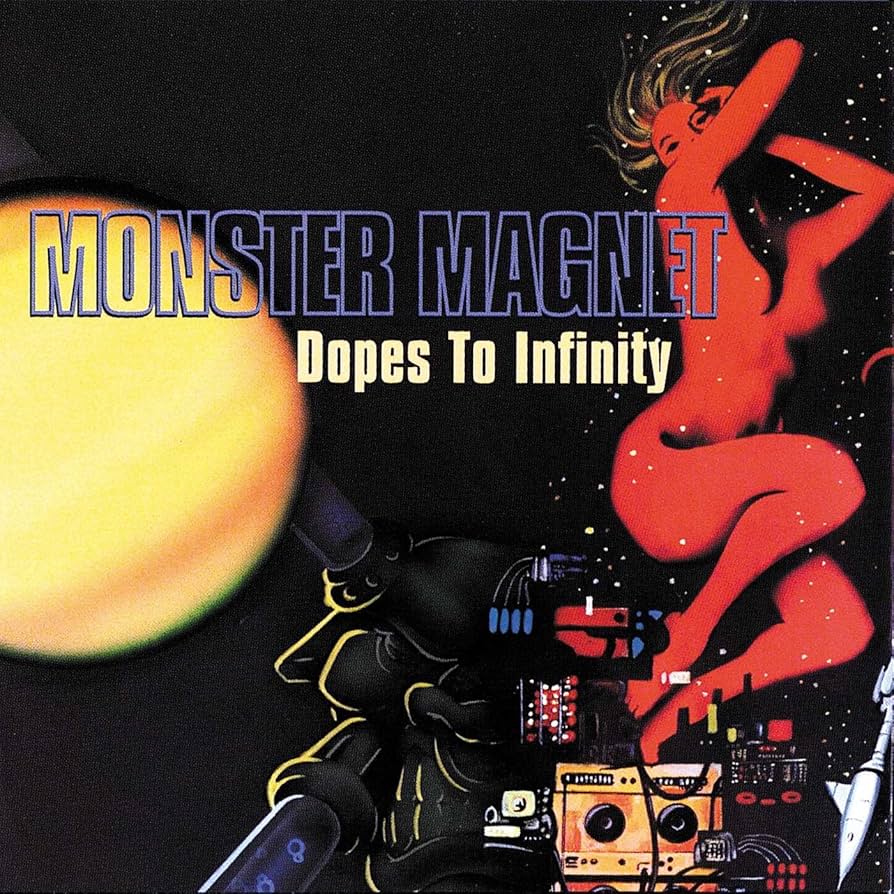
In 1995, they released their third album, Dopes to Infinity. They were three years away from their most well-known album, Powertrip, and grunge was having its heyday, almost a year on from Kurt Cobain’s tragic experiment with taking 20-gauge shotgun shells orally. Cobain lived with a cocktail of physical and psychological burdens, and the drugs and alcohol probably didn’t help much. Yet, in the wake of Nirvana’s rise to the top and shocking end, everyone wanted their pound of flesh. Grunge renewed the template for random mopey white kids to get on stage and whinge about everything from their girlfriends’ complaints about them being bad boyfriends to the price of carpet cleaner. This trend would die down a bit in the late 90s as boy bands took over and dominated the pop scene, only to return with gusto as 2000s-era hip hop and nu-metal took the whining and ran with it like Forest Gump.
So it’s not hard to see why Dave Wyndorf was already sick of hearing it by the time they released Dopes to Infinity. In Negasonic Teenage Warhead, he takes square aim at the avalanche of moaning coming out of the rock scene. The music mirrors this bellicosity, with a swaggering groove and a defiant tone that refuses to wind its neck in. Negasonic Teenage Warhead is carried by brash, attention-seeking guitar licks that go along with the headstrong lyrics. Monster Magnet were never cock-rock per se, but this has the same ‘don’t harsh my buzz, I’m just out to drink whiskey, do coke, and fuck’ party animal attitude.
Negasonic Teenage Warhead
“Negasonic Teenage… what the shit?! That’s the coolest name ever!” – Deadpool’s not wrong. That is an awesome name.
The song’s name comes from a comic book character – an X-man… X-woman? – and it wouldn’t be the first comic book-influenced song that Monster Magnet have put out, with mellower tracks like God Says No (2001)’s Melt, referencing Marvel artist Jack Kirby.
Wyndorf offers up an enthusiastic rejection of the over-saturation of pessimism in the mid-90s rock scene, and a critique of artists who seemed to resent the fact that they’d, against all odds, managed to attain success. To give the man his due, he might have had a point. Do you understand how wildly difficult it is to succeed in the music industry? To attain Nirvana’s level of fame and fortune? To achieve all of that then still mope about it is…. certainly a choice.
More to the point, Wyndorf seems particularly ticked off by the fact that Cobain’s success spawned so many copycats. If I’m reading things correctly, he was perhaps a little more pissed at the artistic inauthenticity of these imitation acts, than the mere fact that they had joined the parade of skinny dudes in tramp costumes lugging battered amps around and mumbling into second-hand mics…
“Cause every supersonic jerkoff who plugs into the game,
is like every subatomic genius who just invented pain,
I will deny you”
I love the energy on this track, I vibe with it hard. I am thoroughly weary of musical self-pity, and Negasonic Teenage Warhead offers a fantastically confident challenge to its contemporary zeitgeist, with the showmanship, musical flair, and solid chops to back it up. While Monster Magnet may have rejected the melodramatic flouncing that much of rock has a habit of lapsing into, they never seemed to go too far in the other direction. Monster Magnet managed to navigate the line between swagger and arrogance, and that is on display here. The juvenile braggadocio that many artists can lurch into when they engage in this style is mercifully absent, much to the benefit of both the music and the band itself.
I’ve known blokes that fully bought into the blasé ‘rock-n-roll’ hedonism that runs on the conviction that if you just keep doing coke and drinking Jack, listening to Metallica and shagging anything with a pulse, then everything will be fine. While I see the idea, I could never escape the impression that these guys were never thinking more than 10 minutes ahead. Their perception of the world seemed to have narrowed into a cone that was about 10 degrees wide. They just didn’t seem to be aware and didn’t seem to want to be aware, of anything beyond whatever kept the party going.
Worse, I’ve been the kind of incessantly whiney prick that Wyndorf calls out here, and I sympathise. Some advice, because there’s a reasonable chance someone reading this is that guy; If you’re that guy, get some perspective: You are not the only person who has ever been hurt. Nobody else needs to hear it. I know we’re all supposed to be about openness and emotionally vulnerable and whatever in this day and age, but there’s a time and place. The reality is that 95% of the time, it ain’t the time nor the place and people have their own shit to deal with. You are not the main character.
There’s a quote from Killer Mike on modern rap: “I think what White people brought was self-pity […] How you deal with your suffering can make you extraordinary. Are you going to use it for self-pity or are you going to use it to help others?”
And that’s a lot of problem with grunge and then nu-metal. It was just chock-full of middle-class white dudes kvetching about… what? I don’t know. It became a parody of itself. It became a precursor case study to the stadium-filling ‘bro-country’ (“got a beer in mah beer and a Chevy in muh truhk…”). Does anybody know what Korn are still whining about? The less said about Fred Durst’s trend-chasing oscillations between presenting as a hard-worn street kid on one track and a down-and-out everyman the next, the better…
But on the other hand, the mopey tone is what builds the fans. Face it: This music was aimed directly at teenagers without the emotional maturity or life experience to notice that the melodramatic melancholia they were ranting along to was as cringe as it was. And to do otherwise is to risk the very fanbase you owe your success to.
Well, you might say, it’s up to the artist to just move on. Which, in theory, is a totally reasonable response. But anybody who has ever watched a fanbase react to any artist, across mediums, do something other than a flaccid rehash of what the fans have glommed onto, knows all too well just how unreasonable the backlash they can expect from their so-called supporters will be. Should you dare to move in a new direction and experiment with new ideas, you can expect to face a mass hysterical bitch fit the likes of which would give any toddler a serious run for their money. Look at Metallica. They do anything at all, and the resounding feedback they seem to get is: “Just make The Black Album again”. This seems particularly acute in cases where the artist’s fame and fortune is built off their own pain, as seen with Aesop Rock, whose fanbase seems split into at least three segments along the early, middle, and contemporary eras of his music career.
In contrast to the ideal of artistic development, bands like Deicide have made, effectively, the same song on repeat for literal decades. Album in, album out, nothing changes. I don’t understand how they don’t turn up to the studio, start chugging, and then one of them turns around and goes “Right, onto song 2.” And another responds, “What? No, dude, we were just playing song 2.” “Really? I was playing song 1…” And the bassist perks up like, “Wait, you guys were playing that? I was playing song 3!”
For a genre that is broadly perceived in very select terms, Grunge’s early period contained more variety than people might give it credit for. Contrary to the stereotype, Soundgarden provide a fantastic example of grunge that didn’t revolve entirely around the image of a vocalist with depression and a heroin addiction, moving from the frenetic punk energy of Ty Cobb and the defiant chant “hard-headed, fuck you all!”, to the down-tuned grime of 4th of July – a song so heavy that it puts most modern Doom Metal acts to shame. Alice in Chains, likewise, mixed up their sounds and themes and avoided the one-note malaise that started to characterise grunge as a genre from the latter half of the 90s on. Compare their most well-known song, Man in the Box, with a groove that is almost pornographic in places, against the wrenching lamentations of Would? Then compare that picture to the one that seemed to be painted of grunge as a whole after the world became obsessed with the scene’s alarming fixation on suicide and hard drugs and saw it only through that lens. While melancholy and mental health remained core pillars and themes throughout, the perception that grunge artists were uniformly droning and mumbling over weary guitar licks is a lamentable misconception.
Not everything needs to sound like Wind, Earth and Fire, Ghost of a Thousand, or Motley Crue. On the other hand, I suppose the question that Negasonic Teenage Warhead, and the broader criticism therein, is where do you draw the line on expressions of pain?
Machismo characterised much of the 80s hair rock and metal scene, reminiscent of Blackadder’s Lord Flashheart: “Just because I can give multiple orgasms to the furniture just by sitting on it, doesn’t mean that I’m not sick of this damn war: the blood, the noise, the endless poetry!” The point of contrast emerging from the unfortunate fact that much of the 80s rock scene seemed to play it straight, lacking the self-awareness to recognise the absurdity of their constructed image and mock the overcompensatory bravado they were trading on. It got bad enough that the emergent genre of ‘cock rock’ actually pissed off a lot of the regular metal community. Until, of course, we ended up with Steel Panther, who took the premise of cock rock to its logical extreme… Ironically, they ended up with the exact same problem that Deicide did: They had one song because they had one subject. I suppose you could theoretically stretch the various pillars of Glam Metal out into different songs – one song for cocaine, one for sex, and one for getting rat-arsed. Congratulations, you can just about fill an EP.
Now that we’ve nailed down the artistic boundary lines of self-expression, we can move on to the follow-up: Do your problems suddenly disappear because you succeed? I’m not saying a couple of million quid and more groupies than I’d know what to do with wouldn’t go amiss right now, but if history is anything to go by, it doesn’t seem to be the end to all problems. If fame and fortune granted rock stars eternal happiness, and by extension concluded that they should be happy with their lives, then how do we explain Kurt Cobain, Chester Bennington, and Chris Cornell? To say nothing of an avalanche of others. The grunge scene alone is scattered with the corpses of heroin overdoses. The music scene is littered with hangings, gunshots, and pills…
I’m sticking with my pet theory that the Cornells and Cobains of the world weren’t the people that Wyndorf was addressing, but rather the monetisation of manufactured pain – art devolved to LinkedIn; a timeline of pathetic anecdotes milked until blood seeps from between the cracks in your phone screen…
What’s the engagement metrics on meth addiction? Can we engineer a cot death for clout or does Hubspot think that will get fewer likes than a cat video? Is there a way to spin a leukaemia diagnosis into broetry about ‘The Grind’? Do you get a pat on the head from management yet? What does HR think?
 Words and Chaos
Leave a comment