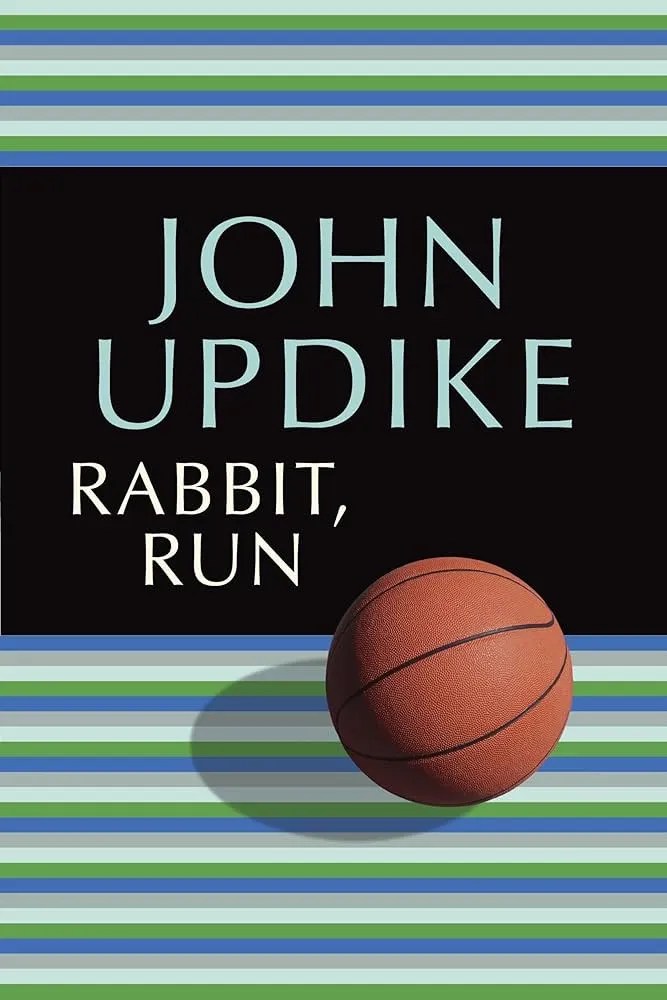
Read through the adventures of a horny man in 1950s suburbia in John Updike’s Rabbit, Run
Sex isn’t special.
It is one of the most basic bitch things about us. Evolution conspired to throw a whole heap of nerve endings around our genitalia so that, when stimulated, they would send chemical signals to the brain, which would convert them into a cocktail of neurochemicals, which would, in turn, send new signals back to the body, triggering autonomic reflexes, resulting in orgasm. There is no purpose to this. Orgasm results in the fertilisation of eggs and thus reproduction, true, but this does not imply a conscious schematic. Purpose implies premeditated design. That is not how evolution works. This is just a series of interlinked chemical mechanisms produced over millennia of reconfiguration, random adjustment, and Darwinian culling. That’s it.
This is, apparently, not the view of John Updike, or at least that of Harry ‘Rabbit’ Angstrom, protagonist of Updike’s 1960 novel, Rabbit, Run. The book marks the beginning of a series of four novels, that would go on to find critical acclaim for his literary talents and Updike would go on to win the Pulitzer Prize twice – a feat that has only been managed by a handful of authors. Rabbit, Run follows Harry Angstrom, a mid-20s middle class mid-wit on a series of ill-conceived escapades as he attempts to reconcile his day-to-day state of small-town drudgery with the giddy heights of… high school basketball stardom. His answer to his quarter-life crisis, it seems, is to fixate on sex. This in and of itself isn’t a problem. If anything the use of sexual release as a compensatory crutch to distract from personal problems is a well-worn artistic theme. But in Rabbit, Run sex is less an symbol of psychological disturbance and more an omnipresent fog that pervades the narrative like the smell of cat piss wafting from beneath the floorboards.
I see why guys like this give women the ick. Angstrom is presented to us, in ironically cocksure fashion, as a guy who has women all figured out. John Updike then proceeds to provide us with almost 100,000 words of evidence to the complete contrary. I’d like to think that Angstrom’s concerning self-delusion is the point Updike was getting at, and that we’re looking at an inherently ridiculous character. Certainly, the bizarre conclusions that he reaches about the ways in which the other characters respond to his total lack of social grace or ability to read a room would indicate that we’re reading a farce. But that’s not really what I got from Rabbit, Run. It has a bleak comic tone at times, but I’m not certain that what I found funny was intended to be.
I cannot, for the life of me, imagine any woman who, encountering a man like Rabbit, would so much as mist her panties over him. If anything, the contrary is true. Which is ironic, given that this guy shares a nickname with a popular type of vibrator… This is probably insulting to the vibrator – it would probably be capable of more basic humanity than is ever demonstrated by Angstrom. The guy has anti-charisma. He oscillates between wheedling cloying sex pest in one paragraph, and arrogant yapping pseudo-patriarch in the next. If he were real, every time he stepped into a room, women would begin to frantically rub Aloe vera into their vulvas to counteract the sudden violent withdrawal of moisture.
Is this the vaunted model of ‘masculinity’ that we’ve all been nauseatingly assured is missing from contemporary society? Men with less emotional intelligence and empathy than a bag of overripe trash? A guy who walks into a local minister’s home and immediately slaps that man’s wife’s arse? And is thereafter irrationally convinced that she wants to sleep with him despite no evidence to suggest that’s true. Whether or not you sympathise with the #MeToo movement, Rabbit is the absolute poster child for the laundry list of disturbing behaviours that women were complaining about in 2017.
Updike’s character study of a boomer sex pest
This is why publishing has distanced itself from so-called ‘male-oriented’ literature. Because so much of it is just banal men waxing lyrical about how much they like an orgasm. Brilliant. So does everyone. That’s the entire point of an orgasm. That doesn’t make you special. It’s literally biologically hardcoded into us. Your ability to fill a condom isn’t any more interesting than mine or anybody else’s.
I’m not one to harp on about the ills and immorality of objectification and blah blah blah, but Jesus wept, Updike is weird. I repeatedly wondered if, on reading over his drafts, he ever thought “Yeah, that’s a bit much…” Perhaps the weirdness is the point? More or less anyone can relate to the simple base act of seeing a person and briefly thinking, ‘That person is attractive’, ‘He’s got nice arms’, ‘She’s got a nice rack’, ‘They’re in good shape’, etc. Single-second acknowledgements as to whether or not we like how another human looks and perhaps a judgement as to whether or not we might consider schtupping them. These are just the basic rules of society: You can window shop. You don’t touch the merchandise. You don’t make anyone uncomfortable.
Updike is a whole other level. Every time a woman is within a hundred metres of Harry Angstrom we get a frankly creepy lecture on the details of her legs, body, breasts, lips, forehead, or whatever else has caught his fancy at that moment, and then usually a teenage fantasy about touching her. Every conceivable incidental act from a woman is somehow interpreted as a signal that they want to shag him. Quite literally, in part 3, he spends a flatly pathetic amount of time convinced that a woman “wanted him to really nail her.” Where did he get this idea? Well, he thinks this because in the previous scene, and I’m not joking, she winked at him. You what, mate? He sees the same woman sitting in a church and decides that her sitting on a pew is deliberately targeted at him and that it is also, bafflingly, sexual. The book is stuffed with these bizarre sleazy moments. These are not the dispassionate acknowledgements of the ‘hard bodies’ of American Psycho. These are obsessive and protracted and you just feel extremely slimy reading them.
I get it, I quite like my own penis. Nobody else cares. Not in the slightest. Why should they? I don’t know about anyone else, but I got chronically bored long before I was halfway through my twenties, with people whose primary subject of discussion was their latest hook-up. Cool. Glad you had fun. I could not care less. Unless there is something particularly out of the ordinary about the latest bout of gasping and grunting, change the fucking channel.
You might be familiar with the saying ‘Everything is about sex, except sex; sex is about power’. And it becomes very true here. Rabbit’s sense of self is bound up with the very American preoccupation of turning the whole of existence into a zero-sum game. He absolutely must win, though how he defines this is nebulous. Presumably, his view of sex reflects this approach to life: To shag is to win, to fail to shag to lose. To win is to attain some amount of power, presumably. This might explain why he is so uncomfortably pushy on this issue – repeatedly ignoring clear discomfort and rejection from women, actively intruding into their apartments and then refusing to leave, as in section 1. But Harry has no power and despite sleeping with several women, doesn’t magically derive power from ejaculating. Who’d have thought?

Although I do find this link between witnessed orgasm and status games to be an accurate reflection of reality. Men seem to have an almost football-team attitude to other guys’ sex lives. I found that other people had more of an interest in my sex life than I did. Have you ever pulled someone, and then met your mates a week later, and received a bunch of congratulatory backslapping? I have. It was thoroughly weird. Sometime later I mentioned this to a friend. He said they were just rooting for me. Sex comes with a scoreboard. This weird socio-competitive approach to a basic biological impulse is located somewhere between bemusing and contemptible. Then again, I suppose we do have the saying ‘any hole’s a goal’. Like Angstrom, I had, apparently, won. It never occurred to me to treat it in those terms. It was just something that happened and then I moved on. An event I’d approached in the same way I’d order a cup of coffee, was, to them, in some way significant.
In part 2, Angstrom’s juvenile competitive pettiness mutates into a pitiful argument about whether or not the woman he’s having an affair with, should suck him off because he’s jealous of some other guy who he thinks she might have sucked off in the past. But he is incapable of naming the act, so he makes weird allusions, and once again bounces from pathetic wheedling to thoroughly unattractive aggression. Oral sex is distorted into a form of punishment and manipulation: “Tonight you turned against me. I need to see you on your knees.” Instead of stabbing him, she gives in.
Why does she do this? We get a short sub-section from her point of view about how she thinks that Harry is, despite all evidence to the contrary, a great guy. Is this seriously what Updike thought of as an attractive, if flawed, man? How? I just cannot follow the logic. I get it, dizzy dames, no logic applied, etc – perhaps that’s the perception reflected here? It still doesn’t track. Harry Angstrom has the charisma of a cum sock. He’s a pre-Internet Twitter chud. The level of desperation that you would have to be at to even consider shagging this bloke, is like the modern equivalent of those weirdos who donate thousands of dollars to influencers in the hope that they will tweet their usernames or something.
The alternative is that she’s been abused in the past and now runs through the academically familiar loop of searching for people who reflect a familiar, if unhealthy, life pattern. But unless I missed something, there either wasn’t enough dedicated to that idea, or it just wasn’t there. So again, we’re back to the question: Why would anybody in the known universe sleep with Harry Angstrom, let alone think he has any value beyond some dubious throwaway dick?
I get it, the 1950s were a different time, this is just fiction, yada yada, but fiction is reflective of the world it comes from. I am a hyper-independent man surviving in a hyper-individualistic world far removed from Rabbit, Run‘s parochial 1950s American suburbia. In Updike’s novel, the community knows everything and everyone. In my world people broadcast everything but nobody knows anyone. As the first quarter of the 21st century shambles into the second, my experience of mag-dumps of nomadic transaction and paranoid panoptic information recall, contrast with Updike’s web of rooted connections and casual interpersonal violation. If Updike’s vision of 1950s American suburbia is in any way authentic to the period, it says something truly revealing about anybody who idolises that era. The mindsets illustrated in these characters are, at best, lamentable.
All writing, in some way, reflects its author, though it is rarely the case that the writing is a direct authorial mouthpiece. An author might reflect the world back at itself, take an instance of the world and enlarge it, or use it to illustrate some idea or question that a writer has. The point I’m getting at is that a novel is not always a straightforward translation of an author’s perceptions onto the page. It has almost always been filtered and changed by any number of factors. So I am inclined, despite Updike’s obsessive fixations, to maintain some distance between the character and the author. That is important in every piece of art. I sincerely, desperately hope that this book doesn’t reflect the perceptions of John Updike as a real-life person. Because dear God.
All of this bipolar vacillating stems from Rabbit’s high school days when he used to be some kind of local basketball star. That’s it. The root cause of Angstrom’s inflated ego is his ability to beat other children at throwing a ball through a hoop. Angstrom squabbles with various other guys from that time, all of whom are just as sad and skeezy as he is. There is something important inadvertently reflected about our contemporary discourse on concepts of ‘adulthood’ and life milestones in Updike’s novel. Despite the fact that the men therein have all hit the supposed milestones for being a ‘successful’ or ‘whole’ man in modern society, they’re all shockingly juvenile. Every single man in this book has peaked before they were 20, and then never improved or gotten over it. When people talk about entitled male boomers, Angstrom is an archetypal portrayal. If anything, he is even more of a disappointing human than you’d expect.
We see this in real life all the time. Guys who clearly had some kind of clout on a secondary school playground, or were the life of the party in A-levels and perhaps the first year of university. And then real life catches up to them and they can’t hack it, and decades later they overcompensate for their perceived fall in status, by acting the same way they did on a playground. And you see these guys, grimace, and feel a bit sorry for them and their complete lack of self-awareness. And then a pigeon catches your eye and their existence slides out of your skull like a TikTok short.
That is Rabbit, Run through and through. A series of unimpressive, thoroughly entitled, thoroughly blinkered man-children who just never left late adolescence. They’ve hit all the socio-cultural milestones, and none of it has helped. It’s just given other bits of society a metric to point at, by which they can sustain the pretence that the collective whole is doing better than it really is and doesn’t just deserve to collapse and swallow them with it.
At one point Harry goes home horny and frames that emotion in angelic terms. He then laments on the fact that “he has come home from church carrying something precious for Janice” but cannot deliver to her this gift beyond value… And again, there’s that profound sense that what we are reading should be an egregious farce or a black comedy, but the framing denies this conclusion. We are left with the unsettling notion that Angstrom sincerely believes his own absurdities. This story just isn’t told in a way that suggests that it should be taken to be deliberately humorous, and as I said, I have trouble sussing out how much of Updike’s worldview we’re seeing here. To add to that, we all know at least one guy, probably more, who genuinely seems to believe that they are some sort of divine gift to women. Where this mass idiocy comes from is anyone’s guess. Some spasm of evolutionary ego? A psychological trick to get the meat thing to copulate by convincing it that the universe actually cares?
Lads: From one man to another, I promise you that your bellend is not the best thing since sliced bread. Just stop.
Rabbit, Run and the run-on sentence
Rabbit, Run is a masterclass in well-crafted but masturbatory prose. As is so often the case with literary fiction, Updike’s prose reflects a concerted exercise in thematically circling a drain. He writes very well and individual sentences are very pretty, but page after page is just endless tedious details that, while painting a very pretty mind picture, are functionally pointless. This is ok in moderation – by all means if you want to describe something in detail, then have at it. However, if you’re going to give people 100,000 words, you can’t have 50,000 of them just be random minutia on the way a gear stick feels as they shift it to turn a corner, or what they think about cheeseburgers, or some kind of ad-hoc seminar on tool sheds, if very little of this cumulative bulk of words actually tells us anything of value about the setting or the character. These large chunks of description could be strategically used to build tone and accentuate points of emphasis or reinforce thematic importance. As it is, we get text dumps of broadly extraneous minutia that add little more than word count. Updike’s prose feels flabby too much of the time.
In the art world, you don’t put a sketch book up in a show. You enter a small number of pieces and display them if they get through, and what the audience sees is those select final pieces. Where some writers are concerned, it seems like we’re seeing the whole damn sketchbook. Page after page after page of scene study or character interaction or detours through the minutia of someone’s memory of an event that is tangentially related to the ongoing drama.
The kicker is that Updike is obviously very capable of getting at the amusing things people think and the way they betray them, such as the scene in which Eccels is interviewing Mary Angstrom, who is washing clothes in a sink. She very quickly betrays her insecurity, ascribing someone’s innocent comment about her not having a washing machine, as a venomous attack on her and an assertion of socio-economic status.
To be fair, I found that the book felt flabby primarily in the front half. This aimless abundance of prose reins itself in over the course of the novel. Updike doesn’t stop writing heaped blocks of descriptive text, just that they start to better serve the broader metaphors. The scenes towards the end of Rabbit, frantic and running through a forest, reducing him wholesale to the animal, or the harrowing scene where Janice is looking after Rebecca, are passages where the description and the themes come together to paint a more complete picture. In those moments, Updike’s per-sentence mastery adds brilliantly to the scenes, layering on bit by bit the implications, tone and detail. That and it’s just nice to have Updike going into torturous detail about anything other than a woman for a change…
I still prefer the more clipped shorter prose of Baldwin, Ballard, or Hemmingway. I can certainly respect the craftsmanship on display here, but much like the ceilings of Strawberry Hill House, the sheer mass of detailing can make it hard to know what to focus on. This descriptive nymphomania stops helping the writing and starts to hinder it. Lacking a focal point or direction, you just have an avalanche of words dumped on you, but unlike the ceilings of Strawberry Hill, a story is not just there to look pretty.
Perhaps you just have to be more of an aesthete to really appreciate Updike. Mervyn Peake strikes a decent balance between the short punchy delivery of the Hemmingway-style writers and authors like Updike and Donna Tartt. In contrast to the brisk sentences of Baldwin, or the word piles of Tartt, Peake used his considerable descriptive talent strategically, saving the long ultra-detailed chunks for moments in which he wanted to set the scene and tone, and dialling it back in moments where it wasn’t necessary to go into the pico-metre spacings of the individual cracks of a character’s pores.
Updike certainly isn’t anywhere near the abject self-fellating pomposity of something like Ian McEwan’s Saturday or the desperate pleading overcompensation of David Foster Wallace’s Infinite Jest, but more than once you are compelled to start skimming pages until he stops yet another episode of protracted waffling and gets to the point.
And what is the point? The point, without fail, is that Harry is horny. Even when the final tragedy of the novel has unfolded, Harry still filters it through the end of his prick.
Rabbit runs its mouth, and the onset of apathy
I recognise the motions of fault. To his credit, Updike does an admirable job of capturing the hollow awkwardness that permeates everything in the wake of some colossal failure from which we are nevertheless spared the extent of punishment. Reserved manners, shifts of approach, the jigsaw rearranging itself. And yet Harry persists in self-indulgence. He becomes some abject humiliation in the semblance of a human. I do not recognise this. One accepts their judgement without complaint. One does not object to their punishment. If one is permitted anything at such times, it is only a silent gratitude if the sentence is more lenient than deserved. Do not seek help. Do not seek mercy.
I’m in favour of characters that I don’t necessarily like. I’m firmly in the camp that recognises that a good character does not have to be an enjoyed character. But as with Last Exit to Brooklyn, I’m trying to work out what Updike wanted me to feel towards his characters at the end. Because I don’t feel anything. For the final stretch of the novel, I was just numb to them all, Harry in particular. He represented little more than some manner of disposable self-pitying detritus. A manipulable input from which one could theoretically attain some kind of vaguely interesting output if plied with the right catalyst. Put it in a maze, show it a vulva, see how it runs.
But there was nothing to learn. This is the input. This is the output. What did you expect?
In the afterword, Updike mentions that one of the things that compelled him to write this was Jack Kerouac’s 1957 novel, On the Road, a powerful exhortation to young people to ‘cut loose’. Updike doesn’t seem to have liked this. Perhaps because Kerouac’s characters capable of negotiating a simple conversation without humiliating themselves or insulting everyone in a mile radius. Updike intended to paint a more “realistic” picture of what happens to a man who goes about ‘cutting loose’. But Updike has misinterpreted the spirit of Kerouac’s advice. Kerouac’s novel sees a grand road trip through America, leaving nobody behind and causing no drama. A step back from the ‘way-it-is-done’ of society and individualistic will to power reclamation of power and agency. Updike suggests that this is somehow damaging to the ‘social weave’. Fuck the social weave. If a society is broken by an individual acting in accordance with their will to no detriment, then that society deserves to die.
I am extremely sceptical as to whether Rabbit, Run offers anything close to a realistic portrayal of his interpretation. Are we to take Updike’s claim of Rabbit, Run as being a realistic portrayal of cutting loose, to suggest that a “real” person is little more than a socially inept sex pest? It reads more like another vapid traditionalist clinging to another dead past, insisting that things absolutely must stay the same come hell or high water. Why? Because it’s what they know and change is scary.
And what of this rabbit motif? Well, what is a rabbit? A rabbit is horny and scared, hounded by predators until an ignominious death; its neck crunched between the slavering jaws of a wolf. But Harry has no predators and his flight is no will to power attempt at self-determination. Why is he fleeing? Because he was a basketball star in the local community a few years ago and that was the high point of his life. Because his alcoholic wife isn’t a blow-up doll. Harry Angstrom doesn’t cut loose, Harry Angstrom just refuses to take responsibility for himself. And he is worthless for it.
And so we see that Updike misinterprets cutting loose as a flight from responsibility. This is not the case. The simple act of driving across a country and listening to jazz music can only be interpreted as a flight from responsibility if you somehow contort the definition of responsibility to be ‘capitulate’. This is not the case. You see, the thing about responsibility is that it’s responsibility. That’s why it’s called ‘responsibility’.
And is Kerouac running? I don’t think so. If he is, what from? Does mere movement inherently translate to flight? How so? Do I flee to the shops? Do you flee towards your job? Does an army flee towards its enemies? Updike might well suggest cutting loose suggests a flight from tradition, and that seems to be borne out by Angstrom’s repeated erratic affairs. But tradition is there to be stabbed and the corpse left to rot in a ditch. And Harry Angstrom is no parallel to Sal Paradise.
 Words and Chaos
Leave a comment