Does the trend towards authoritarianism and infringement of the right to privacy suggest an increasing elite panic?
Governments around the world seem to be going through a control freak phase. As ever, in the developed world, the United Kingdom is leading the charge to bring standards of public paranoia in line with the nations of tin-horn dictators. However, despite their questionable track record, the British Government’s ongoing shift towards authoritarianism may not be a carefully machinated political strategy; in the broader context, it may be an indicator of elite panic.
When those in power feel threatened by the growing unrest, they overreact, tightening their grip on authority, seizing control of the public narrative, and consolidating power. While the Online Safety Act has shone a laser pointer on the issue, the wider context suggests something more insidious. Far from protecting the children, the broader picture indicates that the government’s actions are more concerned with protecting those in privileged positions from legitimate scrutiny and dissent.
It had been clear since day 1 that Starmer has sought to keep a tight rein on his party, following the protracted media fiasco surrounding accusations of antisemitism during Jeremy Corbyn’s leadership. This has manifested in sweeping action and retaliation against pushback within his party, which to some may be interpreted as the suppression of internal dissent.
That alone might be understandable: A Prime Minister seeking to clean up the tarnished reputation of their party is likely to enforce rigid standards of behaviour. However, in the broader context, Labour’s enforcement of rigid in-group hierarchy, mirrored by their escalating crackdowns on public expression and protest, goes somewhat further than a mere clean-up exercise.
What is elite panic?
Elite panic, in brief, is an overreaction by politicians, business leaders, media figures, and other societal elites during crisis periods. This excess of fear manifests as a slide towards authoritarianism and suppression, and the broad attitude that the public is incapable of acting responsibly. It’s almost the antithesis of Deleuze’s ‘Societies of Control’, in that it seeks to restrict movement instead of promote it, and limit information access instead of encouraging its dissemination. According to Caron Chess and Lee Clarke, who coined the term in their 2008 paper, Elites and Panic: More to Fear than Fear Itself. It is marked by overreliance on law enforcement, scapegoating, and rushing through political reform.
Palestine Action and questionable classification
The British Government’s decision to label ‘Palestine Action’ a “terrorist organisation.”, for instance, has become emblematic of the government’s insistence on a hard divide between acceptable and unacceptable opinion. In the shadow of plummeting approval, mass arrests at peaceful demonstrations are not symptomatic of a confident leadership; they suggest, rather, the flailing temper tantrums of elites terrified of losing control.
So, who are Palestine Action and what have they done to be put on the terrorist list? Palestinian Action claims to be “committed to ending global participation in Israel’s genocidal and apartheid regime.” The group was responsible for an ‘attack’ on an RAF base on 20th June in which activists sprayed red paint into military aircraft turbines used by the RAF for refuelling purposes. This was one in a string of similar vandalism attacks on properties linked to weapons manufacturing for Israel. The group has caused millions of pounds worth of ‘damage’ across various incidents, although it is notable that the mere act of chucking paint at some aircraft turbines was apparently worth £7 million in damages.
Perhaps I’m missing something here, but I’d love to see the invoice for that. Why is anybody using bullets and shells against military aircraft? Just throw paintballs at them! I didn’t realise B&Q was a sodding arms dealership!
One of the Home Office’s criteria for the terrorist designation is “involves serious damage to property”. Regardless of where you draw your line, red paint on an aircraft propeller hardly seems to constitute serious damage. So, regardless of your stance on the Gaza conflict or Palestine Action, the Home Office’s credibility is more than a little stretched in this case, and the British public aren’t the only people to think so. Recently, the UN Human Rights Chief, Volker Türk, branded the move a ‘”disturbing” misuse of counter-terrorism legislation’.
A brief history of recent government erosion of civil liberties
The recent attacks by the government on wider public dissent and the lurch towards infringement of the right to privacy seems to lend weight to this accusation. This, of course, is far from the first time the government has faced accusations of authoritarianism, and it seems that the British Government has never been able to learn its place where privacy and personal autonomy are concerned.
The Online Safety Act was once again trotted out without public consultation, under the familiar Halloween costume of ‘protecting the children.’ Because isn’t it always? Yes, we’ve often had to protect the poor children from the abominable terror of… let me check my notes… Ah, yes, Wikipedia.

This is, unsurprisingly, a Tory bill, but Labour does not get to walk away from this with clean hands. They’re the ones in power. If they didn’t want this, they could have stopped it. The fact that they didn’t is yet more evidence that there isn’t much difference between either of the two main parties; they all work for the same people.
Ministers were allegedly ‘frustrated by the “overzealous” application of the law’. Because leaving themselves open to litigious backlash is something profit-driven companies are well known for, and there is no way that said ministers could have foreseen this response. Then again, these are the same group of people who seem to have been blindsided by the concept of a VPN.
Parliament gave the usual claim that sticking their noses into everyone’s phones and computers is for public protection. This has never been a credible answer, but it might have held a slight amount of water had they not:
- Immediately followed up by threatening to unleash a crack team of elite gooners to monitor social media.
- Secretly allowed the police to search millions of UK passports with facial recognition technology, without informing the public and with unclear legality.
- The government hadn’t immediately paired this with an expansion in the use of police facial recognition vans, like the world’s most Orwellian cheese and wine board.
- Put the public at severe risk of personal identity data leaks, by offloading the responsibility to the individual platforms. So if you’ve uploaded your passport photo to three different places, you’ve got three times the vulnerability to identity theft. Nice one, ministers.
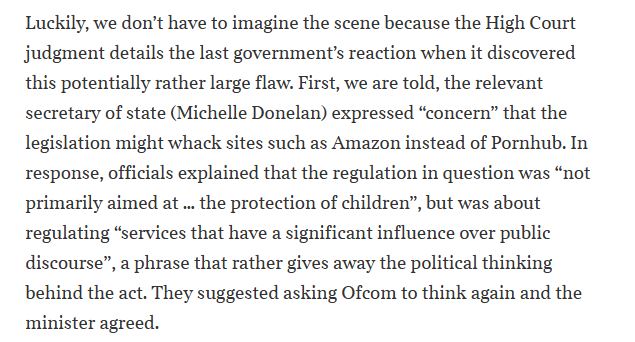
Were they just hoping that all of these dots would somehow go unconnected in the tsunami of the 24-hour news cycle? Or that somehow this all wouldn’t look as suspicious as it does? And if so, how? Our creepy government didn’t learn basic manners the first time Apple told them to piss off, and now tech experts predict that we’ll find them falling back on oily voyeurism before too long.
I’m sure everyone involved will say everything is secure and nobody needs to worry about anything, which is nice and reassuring. And bollocks. As any IT professional will tell you: Nothing is secure. No system is impervious to attack. That’s why you back up your data and don’t click suspicious links. Which is something I’m sure Peter Kyle, who accused his opponents of being on the side of sex offenders, knows all about. But we’ll get to him and his credentials in a bit.
As the FT article points out:
“David Frautschy, a senior director at the Internet Society, an advocacy group, said: “Creating databases to store data used to determine people’s age will act as a honeypot for hackers and malicious actors because they’re compiling valuable information that can be sold afterwards.”
Oh… and then there’s this from The Times:
Are you exhausted? I’m exhausted.
A few highlights from the first quarter of the 21st century:
This latest round of coercion and crackdown, of course, follows on from the Snooper’s Charter under Theresa May and David Cameron in 2016, but the UK has a running history of non-consensual invasive behaviour, so nobody is actually surprised.
In 2008, the government drew up plans to construct a giant database of everybody’s communications data. This included phone calls, emails, and web browsing habits. Allegedly, the text and recordings of emails and phone calls were not going to be kept, just a log of recipients, but I suspect that had more to do with the horrific scaling overheads regarding storage space, rather than any altruistic concern for privacy.
In 2015, documents from whistleblower Edward Snowden exposed the ‘Karma Police’ data harvesting operation by GCHQ. Apologies, that’s a Wikipedia link, and the government might demand you send your sensitive identity data to a random 3rd-party in order to access basic factual information, because apparently we now live in a comically on-the-nose dystopia.
It seems that every few years, the public has to remind this midlife crisis ward full of aging neo-aristocrats to keep their noses out of other people’s business. It’s becoming more than a little tiresome.
On the rights and civil liberties front, there are just as many concerning episodes.
Let’s start with yet more typical Tory tactics. In 2022, we found out that the Johnson government intended to draw up plans for, and implement, a set of four bills that would, according to Declassified UK, “limit the role of the independent judiciary, increase secret courts, repeal the Human Rights Act, and restrict the freedom of the press.” In a truly startling demonstration of brazen gaslighting, Suella Braverman assured a right-wing policy think tank that objections to stripping British citizens of their human rights were somehow a positive move by the government, because there was a “serious risk that the fight for rights undermines democracy”.
Going further back, a TruePublica article notes how in the late 00s and early 2010s that the police had drawn up a startlingly broad database of “domestic extremists” ranging from environmental protestors to severe national security threats such as… Green Party peer, Baroness Jennifer Helen Jones. Truly, she is the darkest of figures to stalk our sceptred isle. They promptly destroyed those records in order to cover up the fact that they were conducting surveillance on their own politicians. This has resulted in the ongoing Undercover Policing Inquiry since 2015.
The final clown out of the ruins of the Conservative Party circus, Rishi Sunak, attempted to clamp down on protests outside parliament, town halls and parties’ offices. Because disrupting the rich and powerful – you know, that thing that a protest is supposed to do – is ‘mob rule’. Then again, what else would you expect out of a disconnected multimillionaire finance bro from the hedge fund world? Although it is worth acknowledging that these crackdowns by the Home Office were found unlawful by the High Court.
And, of course, because the Conservative Party has been captured by the American Libertarians, nothing gets done without the involvement of a think tank with funding from ExxonMobil. And of course, the think thank, Policy Exchange, is linked to the Tufton Street network , a collection of dark money organisations, who were at the heart of the Brexit campaign. And of course, these guys basically own our former Prime Minister and legendary lettuce battler, Liz Truss.
This is just a sampling of the concerning, but unsurprising, moves by our government over the first 25 years of the 21st century. We wait with baited breath to see what they might think of next… I’ve focused on the UK because that is the turf with which I am most familiar, but I’m certain that people in their respective parts of the world can draw parallels to their own situations.
Two interpretations of the moment
The major arguments against the elite panic interpretation are simple: we lack a crisis context. For all that the UK, and the world in general, seems to be actively falling apart, we have not hit a crisis point. Yet.
So two scenarios present themselves:
Scenario one:
Labour’s adversarial stance to individualism is about technocratic consolidation in an attempt to restore legitimacy to a government that is increasingly viewed as inept and out of touch. Trust in institutions is potentially lower than it has ever been, and where government is concerned, many lament the involvement of career politicians appointed to positions they have no right to occupy because they have no experience in their appointed fields whatsoever. So technocratic consolidation would attempt to project the idea that experts were leading a new wave of effective decision-making and policy, driven by accurate insights and experience.
This is somewhat undermined by Labour failing to actually appoint experts to their respective fields. The appointment of Peter Kyle to the position of Secretary of State for Science, Innovation and Technology, for instance, is emblematic of Parliament’s perpetual problem of a lack of real expertise. Peter Kyle has no background in tech. He has no background in science. He has a PhD in community economic development from Sussex University. His background is suited to social issues. Why he’s making decisions on science and technology is anybody’s guess. This suggests the complete opposite of technocratic expert-led governance. It suggests someone ‘failing upwards’.
Scenario two:
The elite are in panic mode. They are in panic mode either because they know something we don’t or they are attempting to get ahead of growing public unrest that they expect to continue to grow.
In the UK this seems to take the form of financial instability. While Boris Johnson was quick to jump to the defence of Canary Wharf, it’s no secret that post-2008, the country has had persistent difficulties. Austerity and Brexit did nothing to benefit the mounting debt pile, the ongoing flight by investors and business from the FTSE to the S&P and the NASDAQ, and the growing discontent around wealth inequality. It’s really something when the government makes several pushes for an increase in the minimum wage, and the result is that we’re only just drawing parity with wages pre-crash.
The rolling impact of the financial crash seemingly cannot be overstated. The bankers ruined the entire global economy by treating it like a casino and then laughed while the proles had to bail them out. We are still paying for it, while their wages and bonuses continue to grow exponentially. Ok, fine, that’s just the invisible hand of the free market, and nobody should complain because if things are bad, that’s your fault, and this is in no way more entitled gaslighting by an arrogant, disconnected donor class. I wonder why people are angry?
Wages have barely grown, relative to inflation, since 2008. And as soon as wages go up, so do rents. But of course, because Parliament and its extended network are full of property moguls, any suggestion of a direly needed rent freeze is unthinkable. Let’s just ignore the fact that the Labour homelessness minister, Rushanara Ali, recently resigned after it came to light that she’d thrown out her tenants and then raised the rent on her east London house by £700. You couldn’t make this up. Are you exhausted? I’m exhausted.
Add to this growing public distrust of governments that are increasingly regarded as having been captured by the same financial elites. Labour’s approval ratings remain rocky, and their solution to a decapitated jobs market is to look for even more taxes. This results in justified overt hostility towards societal and financial elites. Those elites don’t help themselves by threatening to leave the country at the drop of a hat, or pay effectively no tax due to complicated loopholes and financial chicanery – as was the case with Amazon in 2022 when they paid no corporation tax despite earning £222 million in profit. That was the second year in which they paid no corporation tax.
And the question is obvious: why are the working people expected to pay tax when billionaires refuse? We are continuously fed the line that billionaires’ taxes account for the majority of money going into governments, and we need them to spend in the economy and so on. This works on paper, but in reality this is evidently a bold-faced lie. So why don’t governments go after them? Because it’s more financially advantageous to go after the little people. After all, the average person can’t lock governments up with protracted and costly legal battles – they’re just going to pay up.
An ugly snapshot of elite entitlement
“We don’t pay taxes. Only the little people pay taxes.”
-Leona Helmsley
So it is entirely reasonable to perceive the recent overreach in the UK, and now around the Western world, which is experiencing many of the same problems, as a response to growing and prolonged fear of backlash that is manifesting, for instance, in the widespread indifference to the deaths of financial elites such as Brian Thompson and recently Blackstone’s Wesley LePatner.
One suspects that following the assassination of Brian Thompson, when the usual identikit media messaging didn’t land at all, and the public across the world did not buy the narrative nor tow the line, that elites started to notice a shift. Shooting someone dead is usually a pretty cut-and-dry negative. But the dynamic was different. And when right wing talking heads like Ben Shapiro attempted to turn the issue into yet more culture war slop, his own fanbase rejected his ‘thought leadership’ and collectively shrugged. Oh no. Anyway… Brian Thompson was replaced by the next person on the conveyor belt and a vampiric economy churned off. The fact that the media’s performative moral outrage hasn’t changed anything in the months since, should have started some alarm bells. Meanwhile, the underlying rage continues to deepen, not helped by the growing arrogance and entitlement of CEOs such as Tim Gurner, who famously said: “We need to see pain in the economy. We need to remind people that they work for the employer, not the other way around.”
And why stop with Mr. Gurner?
Douglas Rushkoff recounted an episode with a group of ultra-wealthy tech preppers who were trying to plan for societal collapse. As they attempted to navigate basic social interaction with the grace that only a tech billionaires can demonstrate, floating ideas about rigged shock collars and fears about the collapse of crypto, Rushkoff’s advice about pro-social behaviours went largely ignored. Of all the potential examples, at least this one is depressingly comic.
The UK as a whole seems to operate as a dubious money laundering scheme for the wealthy, with London earning the title of the ‘Troika Laundromat’ with the vast UK financial sector actively working to hide flows of suspicious wealth under layers of shell companies.
Roman Abramovich is thought to owe up to a £1 billion in unpaid tax using a network of offshore holdings.
David and Frederick Barclay, owners of the famous Ritz Hotel, have been accused by The Economist of being engaged in fraud and tax evasion. They themselves are part of a growing number of “elites” who dub themselves ‘tax exiles’. A ‘tax exile’ is, apparently, “a person who leaves a country to avoid the payment of income tax or other taxes”. Raising the question: Why are poor people called scroungers and rich people get to be called ‘tax exiles’? An investigation into The Ritz Hotel found that they had not paid any corporation tax in 17 years.
Same story with tycoon Phillip Green.
Same story with tycoon Rich Branson.
Same story with comedian Jimmy Carr.
Same story with former Chancellor Nadhim Zahawi.
And on and on it goes.
In fact, according to the Financial Times, these people who supposedly pay so much more tax than all the rest of us meagre plebs, in actuality, pay substantially less than their fair share. Between 2019 and 2024, HMRC retrieved over double their tax revenue from the wealthy following a lot of work to ‘ensure compliance’. Their tax revenue went from £2.2bn in 2019-20 to £5.2bn in 2023-24. As the FT article highlights:
“The NAO report said: “This raises the possibility that underlying levels of non-compliance among the wealthy population could be much greater than previously thought.”“
And there’s always Leona Helmsley, who went full mask-off and gave us all this staggering pearl of wisdom:
“We don’t pay taxes. Only the little people pay taxes.”
‘Tax the wealthy!’ is the current battle cry. So ubiquitous that even the wealthy, attempting to ingratiate themselves to the working people, are encouraging higher taxes.
But perhaps we don’t even need to tax the wealthy.
Taxing the wealthy does nothing if they don’t pay taxes in the first place. 100% of 0 is still 0. But if you close all the stupid loopholes they’re allowed to brazenly exploit…
Finding out
Meanwhile, tech billionaires spend billions on doomsday bunkers and land purchases. Is this just another weird extravagance purchase from the high-net-worth lot? Couldn’t they feasibly sod off into the ocean on their battleship-sized mega-yachts until the end of the world blows over, or is there really so little hold space in these overcompensation symbols? Why are they sinking vast sums of wealth into hedge bets against societal collapse? Even if you’ve got more money than you know what to do with, surely playing Fallout for real is a bit much. Which suggests that perhaps they do genuinely expect society to start collapsing by 2040 in line with the predictions of the 1972 study “The Limits to Growth” published by the Club of Rome at MIT.
Since that study, a range of literature has been published on the subject of collapse, and a startling number of them seem to agree with the initial 2040 assessment (Gaya Herrington, the Singularity Model). Some, like the Olduvai Theory, put the beginning of industrial decline at about 2030, while others, like the AMOC Climate Tipping Point, are more generous and expect the starting gun to fire about 2060. The Seneca Effect declines to name a specific date, but expects “rapid collapse”.
So, if you believe any of this, we’ve got roughly 5-25 years left in the tank before things really start to go downhill. I’m sceptical, but judging by the elites’ actions, they are at least open to the possibility.
And that’s interesting, considering the increasing global unrest over the last decade. I wonder if any of this lines up with Alexander Chizhevsky’s theory about sunspot cycles and ‘mass excitability’? Seems like the kind of dubious correlation that’s hard to test and come to any conclusion on. Makes great fodder for the conspiracy schizos to froth over, though. Surprised it hasn’t done the rounds on Facebook or TikTok…
Personally, I’m more in favour of linking mass excitability to massive gaps in wealth between the 1% and everybody else, and I’m far from alone. That’s a tangible reason to be pissed off, and people are pissed off. The narratives are breaking down, and the usual vectors of information and propaganda are spinning out of control. And you know what happens when rich people think the peasants are reaching for the pitchforks. As I mentioned in my commentaries on Locke’s Two Treatises of Government, and Rousseau’s The Social Contract, said social contract broadly seems to operate on an ‘FAFO’ basis. It seems like the elites are pushing their luck a lot recently. I wonder whether we are seeing the beginnings of a push back.
And I wonder whether the elites have started to panic.
 Words and Chaos
Leave a comment