h2: As a symbolic representation of socio-cultural fear, zombies are as divided as the rest of us
h3: The monster as mirror
Monsters can often be interpreted as symbolic representations of cultural fear.
The vampire has, throughout history, represented a range of evolving social fears. Some representations, such as the original Dracula, highlight fears of covert invasion from outside cultures and emasculation; because if literature teaches us one thing, it is that there has literally never been a point in history where men have ever felt “manly” enough. Other representations emphasise intemperance or the corrupting influence of wealth and power.
Frankenstein originally highlighted a wariness of scientific endeavour pulling a Tower of Babel and taking on a deific role with disastrous consequences; although to modern society it just looks like a parable about irresponsible parenting.
Robert Louis Stevenson’s 1886 novella ‘The Strange Case of Dr Jekyll and Mr Hyde’ highlights themes of addiction and substance abuse in the UK, such as the ‘Gin Craze’ of the 18th century, which compelled the founding and spread of the temperance movement during the 19th century. Although who can blame them? Henry Mayhew’s work ‘London Labour and the London Poor’ or Jack London’s ‘The People of the Abyss’ are just two amongst a range of texts that illustrate precisely why the Victorian lower classes drank. Given the wretched state of the poor in Victorian England, acutely visualised by the ever-hungering maw of London’s industrial grindhouse and the atrocities perpetuated by pre-libertarian laissez-faire economic systems, wouldn’t you?
In the modern day, removed from the laughable rigidities of Victorian society, though ‘deaths of despair‘ persist, the Jekyll/Hyde character can easily be interpreted as a pre-psychiatric-era symbolic representation of what the Jungians would call the ‘shadow’. If you are cynical, and being a Londoner I am, Jekyll and Hyde simply reflect the rampant hypocrisy and duality of the human race, the vast distance between the public persona and the “real” private person.
John Carpenter’s 1982 film ‘The Thing’ has been widely read as a reflection of McCarthyism and Red Scare paranoia. The titular monster’s amorphous shape shifting and interpersonal paranoia between characters mirrored the social anxiety and God-of-the-gaps-style blank filling of government propaganda, creating a nation in which nobody trusted anybody else.
These are all singular creatures. Overwhelming threats that, while powerful and destructive, are relegated to a representational minority of society, even if they stood in for a group. The implicit message is simply that, as bad as they are, a singular monster can be overcome by an organised group or cohesive community.
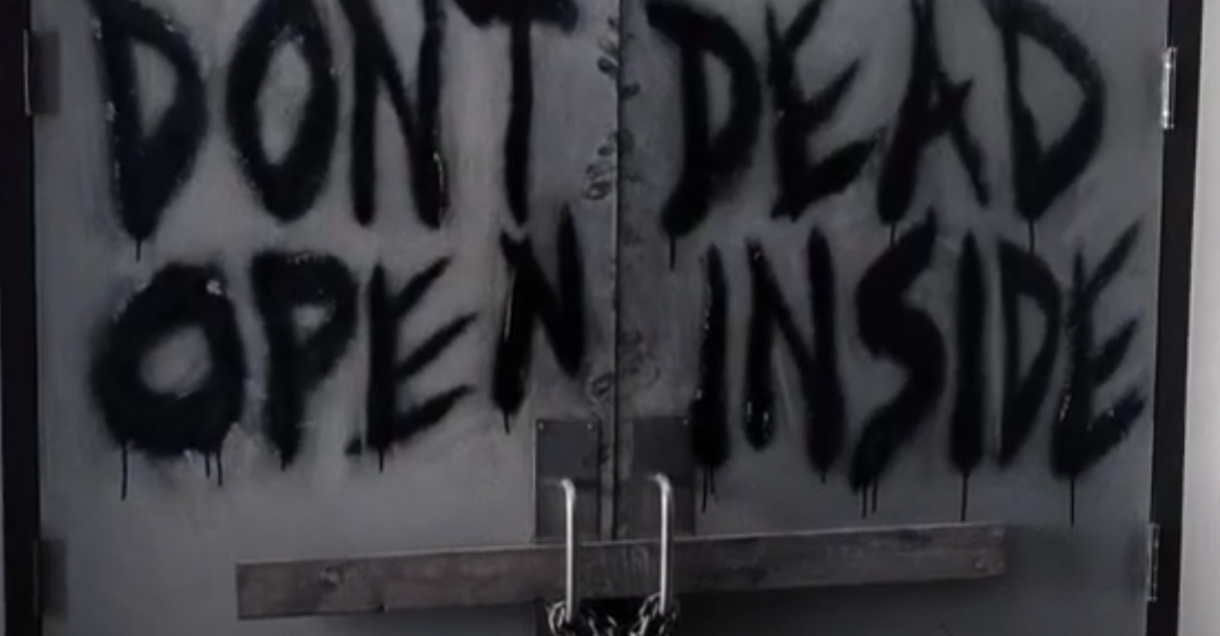
Then there is the zombie.
h3: The zombie and the uncanny reflection.
They outnumber the living. They devour entire societies, spreading faster than the bubonic plague, Covid, or the common cold. They aren’t really any different from us. Just deader. They move in a mass, they consume indiscriminately, they are slow of body and slower of mind. You’ve probably described someone you know in the same terms.
The zombie’s representational strength is not in its overwhelming numbers or its endless hunger. It is in its uncanny reflection of us. In our post-modern hyper-individualistic 21st-century first-world societies, we all strive to differentiate ourselves from those around us. We are exhorted to stand out from the crowd, we fight for distinction in our lives and our careers, the ‘great man of history’ narrative is a great favourite in our culture. Yet we still recognise ourselves in the herd of background stock-characters shuffling between office blocks, industrial tenements, and through vistas of mass-fabricated commerce.
Their undead state is no mistake. The zombie is symbolic of an autophagic techno-capitalist world consuming itself, through a paradoxical loss of individuality and homogenisation of identity, reflected in group think and herd behaviour. Nietzsche’s mass man is a zombie.
As with much of Western commentary on zombies, I’m not going to delve into the original Haitian origins, links to colonialism, et al., will be set aside as I think, for the topic at hand, a derailment into the pre-modern conceptions would add little to the point, if not risk detracting from it, and almost certainly deserve its own spotlight – although I’m sure that is thoroughly gone-over ground by now.
h3: Zombies make no sense
Zombies make no sense. This is not a controversial statement. But it is the problem with zombies. They are not the threat that their own media portrays them as. By now, we’re all familiar with the normal reasons that zombies don’t survive more than a year or two before environmental factors wipe them out. Winter cold and summer heat are highly disagreeable to necrotising flesh. Presumably, they would be constantly decaying anyway, rendering them largely immobile as muscle tissue wastes away and gum decay results in a wholesale loss of teeth.
But the practical physiology of long-term zombie epidemics isn’t what’s bothering me. Zombies had an even more fundamental problem that makes them unviable long before they eat their first person.
I’m not coming at this from a ‘well ackshully’ standpoint. Explanations of viral contagions for modern and sci-fi settings or magic for fantasy settings – it all works for me. As long as it doesn’t break the verisimilitude by contradicting the rules established by the setting, or render itself easily solved by the same ‘a wizard did it’ magic deus ex machina responsible for the zombies in the first place, I’m good.
The popular conception of a zombie is that they want brains. This is not strictly true. George Romero’s original 1968 Night of the Living Dead never specified anything about brains, just a general hunger for flesh. The brain obsession seems to have been a product of a later parody of the genre, Return of the Living Dead. In Return of the Living Dead, the zombies can talk – and they do so to hilarious effect, spawning a series of cultural reference points and call backs, such as the name of the UK metal band ‘Send More Paramedics’. Throughout the Return of the Living Dead, zombies vocalise a specific desire for brains – most notably the enthusiastic vocalisations of ‘Tarman’ – and later a zombie is asked why they want brains, to which it answers that eating brains helps to nullify “the pain of being dead.” As far as explanations go, it’s pretty thin, but Return of the Living Dead didn’t take itself remotely seriously, so it wasn’t a point of contention.
h3: The contradiction of the zombie
Regardless, the point is that zombies are not gourmets. You can sit one down in the Ritz, they’re not likely to quibble if the steak tartare isn’t cooked to perfection or the lamb shoulder is too dry. They’re not likely to notice the difference between the steak or the lamb. To be fair, they’re probably more interested in the waiter, suggesting that the flesh has to be living to make it onto the menu. This is not strictly the case in more modern interpretations – the zombies of the 28 Days/Weeks/Years Later films are alive and unwell. They’re less hungry than they are angry. The Crossed, of the series with the same name, are more a ballistic id than anything else. The point being that you rarely see zombies chowing down on all of the carcasses they make. If they were just looking to fill their bellies, dead flesh would seem to be just as good as any other.
Which is where the problem begins: the basic identity of the zombie is in conflict with itself.
You have:
* An insatiable hungry monster that wants living flesh;
* A viral infection that uses hosts to spread, resulting in mass pandemics of hungry undead.
See the problem?
You can’t have an eternally hungry monster that wants to satiate its abyssal appetite by eating its victims, and also have a creature that is driven to consume, rely on numerical mob tactics driven by the spreading of a viral infection, scientific, magical, or otherwise.
- If zombies bite and move on, like an overgrown, slightly less irritating mosquito, then you get more zombies, but nothing is achieved to satiate the hunger. Presumably, then, the zombies just starve to death;
- If zombies consume what they kill, then you have no more zombies. The initial zombie satiates its hunger, but the contagion has no propagation vector.
Whichever way you slice it, the zombie doesn’t work because fundamental needs that sustain its ‘life’ work against each other. They either propagate and starve to death, or feed themselves but can’t propagate.
h3: So why zombies?
We come back to the conceptual aspect of the monster.
There is, of course, the interpretation of a zombie virus as a rabies analogue, which is basically 28 Days Later’s take. The rabies virus alters neurochemistry, which can result in increased hostility, aggression, and erratic behaviour – [“a small piece of the rabies virus can bind to and inhibit certain receptors in the brain that play a crucial role in regulating the behaviour of mammals. This interferes with communication in the brain and induces frenzied behaviours that favour the transmission of the virus.”](https://www.sciencedaily.com/releases/2017/10/171011091847.htm) This may be the closest thing to zombies that we have in real life – and may have spawned several of our real-world myths regarding undead, revenants, etc.
I’m not blithering on like this just to poke holes in a fictional concept. I’m more interested in drawing attention to the zombie’s dual identity as a symbolic concept that is at war with itself. For a concept to be maximally effective, the representation of that concept has to align with it. And I like zombies as a concept, but I’m also driven to conclude that, because the concept is self-defeating on a mechanical level, it could be better.
And maybe that’s why modern interpretations of the zombie are less concerned with flesh eating, and more generalised violence. If the zombie is a reflection of consumer society, then ‘random acts of murder’ don’t reflect that. Arguably, the zombie isn’t as great a candidate for a reflection of those dual aspects of society as it first seems, depending on whether or not you agree with all of this.
Romero’s original film seemed to be trying to capture both consumption and homogeneity at once, a theme that became more entrenched as the concept of survivors hiding out in giant malls – centres for transaction, commerce, and consumption – became the archetypal image.
- Eating flesh maps to themes of consumption and hunger;
- Viral horde infection maps to themes of crowds, individuality, identity, and conformity.
However, the 28 Days Later series recently released the third film of the franchise, 28 Years Later. And if that vision of the zombie is now the default cultural concept, then the theme has shifted from consumption to conflict.
Rage maps to themes of social division, loss of critical thought, failures of communication, and potentially the loss of community. All pertinent themes for the modern world. It’s interesting to find that they sit alongside questions of consumption and conformity, rather than replacing them as can happen with the symbolic representations of other monsters.
But there are still problems with the mechanics. If your rage virus wants to murder everything in sight, then presumably the carrier of the virus would kill everything it came into contact with before the virus could make use of the new hosts because the hosts are already dead. It doesn’t take long to kill someone, and the ‘modern’ zombies aren’t undead. Then there’s the question of why these mindless rage monsters don’t turn on each other and wipe themselves out before they can become a threat. If they’re so hell bent on ultraviolence, why do they demonstrate horde behaviour? So we arrive back at the initial problem.
h3: An autophagic horde identity crisis
Across the shift, the focus seems to land on homogeneity and the identityless Nietzschean mass man. And so perhaps this is the core fear that the zombie should use as a foundation, working other aspects in around it if possible.
There’s also the option to use the contradictions as the point. After all, modern society does seem to be at war with itself. With the one hand, it creates hostile ecosystems in which only a handful of predators can survive effectively via exponential resource hoarding. With the other, it demands that the rest of the inhabitants find enough dwindling resources to both survive and safeguard their future, while simultaneously demanding that they not only do all this, but also breed new inhabitants to expand on the previous population in an environment that is not structured to sustain the existing population in the first place. And so the world devours itself.
There’s got to be something interesting you can do with that, but it might be a stretch for a zombie.
Whether there is any way to unify the symbolic elements without the core identity of the zombie being lost, remains to be seen. The problem itself is deeply ironic, but I’m sure someone smart can figure out a solution.
It’s not about the zombies, stupid.
The Walking Dead series is one of many instances in which the focus of the horror is redirected away from the monster. Just a handful of episodes in, it’s clear that the tension does not come from the monsters, it comes from the human response to new circumstances. As with the military across the 28 <timeframe> Later films, the horror is most visceral when it is rooted in extreme reactions to extreme circumstances. Zombies aren’t motivated by a conscious decision-making process, they are driven by an animal instinct. A dog might bite you, but chances are that you don’t consider the dog evil – just doing what it was trained to do, or misreading the situation because it has the reasoning ability of… well, of a dog.
But humans are a different matter. In 28 Days Later, Major West becomes more monstrous than the zombies, with a plan to mass enslave women for breeding purposes in order to preserve civilisation. He is calculating, rational, and effective, and the result of all that brain power is arguably worse horror than the zombie apocalypse. Elon Musk wishes he were this competent.
The recontextualisation of the zombie as a vector for human horror allows the zombie to continue being a contradictory mess of elements while not detracting from the drama of the fiction. The audience’s focus is pulled away from the monster to the context in which that monster operates. Perhaps this is what allows the zombie to retain its relevance. They serve as the tray on which the meal is served, but they are not the meal itself.
 Words and Chaos
Leave a comment